
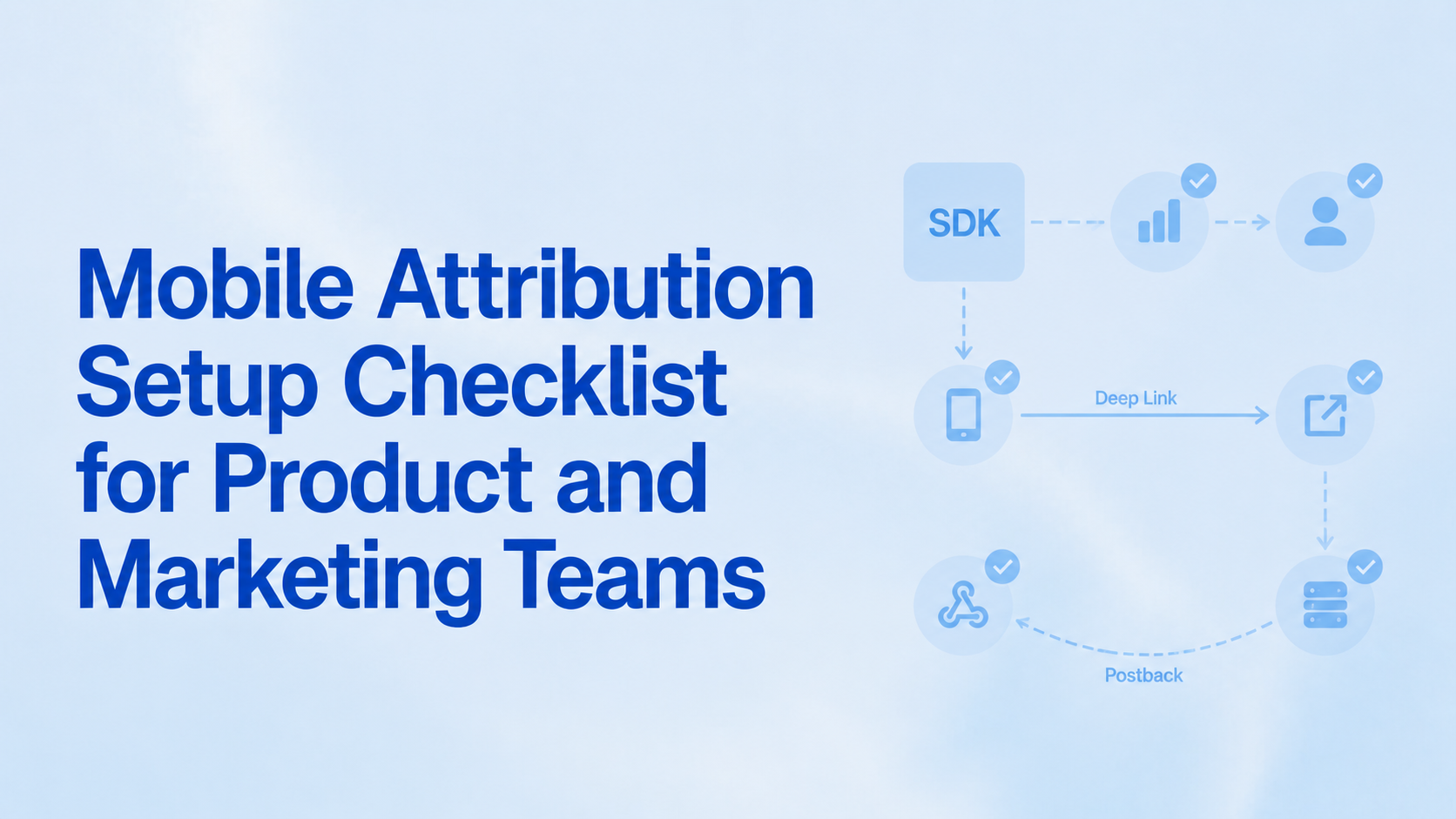
Across the attribution setups we audit, a clear pattern holds: implementations fail on ownership and sequencing, almost never on the tooling. Marketing assumes engineering owns the event map. Engineering assumes marketing signed off on the taxonomy. Both assume someone tested the deep links. Then budget goes live, the Monday report is wrong, and everyone points at the SDK, which was working fine the whole time.
A mobile attribution setup is not a technical task with a marketing dependency. It is a cross-functional project with a technical component, and the projects that succeed are the ones where every task has a named owner, a defined sequence, and an acceptance check before spend flows. This checklist gives you that structure: four phases from kickoff to go-live, what "done" means at each step, and a RACI so nobody assumes their way into a broken launch.
Why Attribution Setups Fail, and It Is Rarely the SDK
Most failed attribution setups fail for organisational reasons, not technical ones: unclear ownership, work done out of order, and no acceptance criteria before budget goes live. The SDK is almost always the healthiest part of the stack.
The recurring failure modes we see in audits:
- Ownership gaps. Nobody is explicitly responsible for the event taxonomy, so it gets whatever defaults the SDK ships with, and revenue is never captured with values attached.
- Sequencing errors. Postbacks get configured before the events they depend on exist, or campaigns launch before deep links are tested.
- No definition of done. "Setup complete" means the SDK compiled, not that installs, events, revenue, and deep links were verified to match reality. The fix is not a better tool. It is a shared plan. When a setup does break after launch, the diagnostic path is covered in our guide to the red flags that mean your MMP setup is broken, but the cheaper move is to prevent the break with a checklist that assigns ownership up front.
The Checklist at a Glance: Four Phases
The setup runs in four phases, each gated by an acceptance check. Do not start a phase until the previous one has passed its check.
- Planning: decide what to measure and who owns it, before any code is written.
- Implementation: install the SDK, instrument events, connect ad networks, configure postbacks.
- QA: test every surface against expected results before a rupee is spent.
- Go-live: monitor the first week and sign off formally. Each phase has an owner of record and a hard gate. The gate for planning is a signed-off measurement plan. The gate for implementation is instrumented events firing in a test environment. The gate for QA is a passed test log. The gate for go-live is a monitored, reconciled first week. Skipping a gate is the single most reliable way to produce a launch that looks fine and reports wrong.
Phase 1, Planning: The Decisions That Belong Before Code
Planning is where marketing earns its place in the setup. Every decision deferred here becomes an engineering rework ticket later. Get these on paper and signed off before implementation starts.
The planning checklist:
- Business questions first. Write the three to five questions the stack must answer (for example, cost per paying user by channel, D7 retention by campaign). Owner: marketing and growth.
- Event taxonomy. Define every event, its properties, and which ones carry revenue values. This is the highest-leverage document in the whole project; our event taxonomy implementation guide covers how to build one that lasts. Owner: product marketing, with engineering feasibility review.
- Attribution windows****. Decide click-through and view-through window lengths that reflect how long your users actually take to convert. Owner: marketing.
- Dashboard requirements. List the cuts you need on day one so BI is not an afterthought. Owner: growth or analytics. Acceptance check: a one-page measurement plan, signed off by marketing, product, and engineering, that names every event and window. No implementation begins without it.
Phase 2, Implementation: SDK, Links, Networks, Postbacks
Implementation is the phase everyone thinks is the whole project. It is roughly a quarter of it. With the plan signed off, the technical work is fast and low-ambiguity.
The implementation checklist:
- SDK install. Integrate the SDK and confirm install attribution fires for organic and paid installs. The Linkrunner quickstart is a representative integration path. Owner: engineering.
- Event instrumentation. Implement the taxonomy from Phase 1, including revenue events with values. This is post-install event tracking, and it is where most revenue reporting quietly breaks. Owner: engineering, with product marketing validating names against the plan.
- Tracking links and deep links. Create the campaign links and configure deferred deep link routing. Owner: engineering, with marketing supplying the destinations.
- Ad network connections and postbacks. Connect Meta, Google, and TikTok, then configure value-based postbacks so networks optimise toward paying users. Owner: engineering, with marketing confirming the events sent. Acceptance check: every planned event fires with correct properties in a test build, and each ad network shows a live connection. Not "the SDK compiled". The events, verified.
Phase 3, QA: Test Cases and Acceptance Criteria Before Budget Flows
QA is the phase that separates trustworthy setups from hopeful ones. The goal is to prove, before spending, that what the dashboard reports matches what actually happened on the device.
The QA checklist, each item with a pass criterion:
- Install attribution: organic, paid, and reinstall cases each attribute to the correct source. Pass: source matches the test condition every time.
- Events and revenue: every event fires once, with correct properties and currency, and no duplicates. Pass: parameter values and counts match the test script.
- Deep links and deferred deep links: a link routes to the right screen, and a link tapped before install routes correctly after install. Pass: destination is exact across a device matrix.
- Postbacks: each network receives the intended event, to the correct account, with no misfires. Pass: the network's event manager shows the expected event. Use the integration testing guidance in the Linkrunner integration testing docs as a model for structuring the test log. The rule for this phase is unambiguous: no budget goes live until every test case has a recorded pass. A test that was "probably fine" is a test that failed.
Phase 4, Go-Live: First-Week Monitoring and Sign-Off
Go-live is not the moment the SDK ships. It is the first week of real spend, watched closely, with a formal sign-off at the end. Attribution problems that hid in QA surface here under real traffic.
The go-live checklist:
-
Daily reconciliation for the first week. Compare MMP installs and revenue against ad network and payment-gateway numbers, and investigate any gap beyond your defined tolerance.
-
Watch for the classic first-week failures: revenue lagging installs, a channel over-claiming, or a deep link silently sending users to the home screen.
-
Set up ongoing hygiene so the setup does not decay. Monthly data-quality checks catch drift before it becomes a quarter of bad reporting; our guide to monthly MMP data quality checks covers what to re-verify.
-
Formal sign-off. A named owner confirms the numbers reconcile and the setup is trustworthy. Add two habits that keep the first week honest:
-
A single owned reconciliation document. One shared sheet comparing MMP, network, and payment numbers each day, owned by one person, beats four people each glancing at their own dashboard and assuming the others agree.
-
A defined tolerance and escalation. Decide in advance what gap counts as noise and what gap triggers investigation, so the first discrepancy produces action rather than a debate about whether it matters. Acceptance check: a first week where MMP numbers reconcile with channel and revenue data within tolerance, signed off by the go-live owner. The most common onboarding mistakes that undermine this week are catalogued in our rundown of MMP onboarding mistakes in the first 30 days.
Who Owns What: The Setup RACI
The single most useful artefact in an attribution setup is a RACI that removes every "I assumed you had it". Assign each task as Responsible, Accountable, Consulted, or Informed before kickoff.
A workable default RACI:
- Measurement plan and business questions: Marketing responsible and accountable; product and engineering consulted.
- Event taxonomy: Product marketing responsible; engineering consulted on feasibility; marketing accountable for coverage.
- SDK, links, postbacks: Engineering responsible; marketing consulted on destinations and events; engineering lead accountable.
- QA and test log: A named QA owner responsible and accountable; marketing and engineering consulted.
- Go-live reconciliation and sign-off: Growth or analytics responsible; the head of growth accountable. The point of writing it down is not bureaucracy. It is that "Accountable" is a single name per row, so when the Monday report is questioned, there is one person who owns the answer rather than a meeting that produces another meeting.
Where a Unified Platform Removes Checklist Items
Part of this checklist exists only because most stacks stitch a separate deep-linking tool to a separate attribution tool. Every connector between them is another thing to configure, test, and re-verify monthly.
Where a unified deep-linking and attribution product shortens the list:
- No connector to QA between the link tool and the MMP, because links are attribution-native by default.
- One SDK to integrate and test, not two, which shrinks both the implementation and QA phases.
- One event taxonomy flowing to attribution and routing, instead of reconciling two definitions. This is not a reason to change tools mid-setup. It is a reason to notice which of your checklist items are inherent to attribution and which are only there because your tools are glued together. Platforms like Linkrunner collapse the second category, which is why setups on a unified stack tend to pass their QA gate faster.
How to Validate the Setup in Your MMP
The checklist tells you what to build; validation proves it works. Before you call the setup done, run these checks in the dashboard itself, because a setup that compiles is not a setup that reports correctly.
- Fire a test install per source. Trigger an organic install, a paid install from each connected network, and a reinstall. Confirm each attributes to the correct source in the dashboard, not to a catch-all bucket.
- Fire every revenue event once, with value. Walk the purchase and subscription flows on a test device and confirm each event appears exactly once, with the correct amount and currency. Duplicates and zero-value events are the two failures that quietly corrupt revenue reporting.
- Route a deferred deep link on a clean device. Tap a campaign link, install, and confirm the app opens on the intended screen after first launch, not the home screen.
- Check postbacks in the network's event manager. Confirm each network receives the mapped event, on the correct account, within its window.
- Produce the flagship cut. Generate cost per paying user by channel and confirm it reconciles with payment data within tolerance. If it does not, a layer is misconfigured, and no amount of spend will fix a broken denominator. Tech Explainer: what "acceptance criteria" means for attribution. In software QA, an acceptance criterion is a testable statement of done. Attribution needs the same rigour, because "it looks live" is not testable. A good criterion reads: "an organic install attributes as organic in 5 of 5 test cases" or "a purchase reports the exact rupee value in the dashboard within two minutes." Each check in this guide has a pass condition for exactly this reason. When every criterion has a recorded pass, the setup is trustworthy; when any is "probably fine," it is not, and the Monday report will find the one you skipped.
Validation is not a separate project. It is the four acceptance gates, run with real test data, before budget flows. Teams that treat it as optional are the teams that spend their first week reconciling instead of optimising.
Frequently Asked Questions
How long should attribution setup take?
The technical implementation is short, often two to four hours for the SDK, but a trustworthy end-to-end setup runs one to two weeks because planning, QA, and first-week reconciliation are where the real work lives. Teams that finish in a day usually skipped the QA gate and pay for it in the first Monday report.
What must marketing decide before engineering starts?
Marketing must sign off the measurement plan first: the business questions, the full event taxonomy with which events carry revenue, and the attribution window lengths. Every one of these left undecided becomes an engineering rework ticket later, so the planning gate exists precisely to force these decisions up front.
Who should own the go-live sign-off?
A single named person on the growth or analytics side, accountable for confirming that MMP numbers reconcile with ad network and payment data within tolerance. Diffusing this across a team is how launches go live with nobody actually certifying the numbers.
Running the Checklist Without the Guesswork
Attribution setups do not break because the technology is hard. They break because four teams each assumed a different person owned the sequencing, and no one defined what "done" meant before the budget went live. Run the four phases in order, gate each one on a real acceptance check, and put a single accountable name on every row of the RACI.
If you want a setup where the deep-linking and attribution layers share one SDK and one event model, so half the QA items simply do not exist, that unified approach is what platforms like Linkrunner are built around. You can request a demo from Linkrunner to walk your setup against it, or start an implementation review with your own team using this checklist. Either way, download the four-phase checklist, assign the owners, and do not let a single phase go live without passing its gate.