
Before the raise, growth was organic and the whole measurement stack was GA4 plus gut feel. The term sheet gets signed, the board expects paid acquisition to inflect the numbers, and the team turns on Meta, Google, and one more channel. Ninety days later, roughly ₹40 lakh is spent, and the three channels report three different install numbers, none of which reconcile with what the bank is showing. The problem is not the spend. The problem is that the measurement stack never changed when the business did.
Funding changes your measurement requirements overnight, and most teams discover this a quarter too late. This guide packages the decision most competitors skip: not what attribution is, but the exact stack a funded startup needs, the order to build it in, who owns each layer, and what it should cost at your scale. It is written for apps crossing roughly 15,000 installs a month with fresh budget and a board that wants answers.
Why Funding Changes Your Measurement Requirements Overnight
The moment you start spending real money on paid acquisition, "how many installs did we get" stops being a useful question and "which spend produced paying users" becomes the only one that matters. Organic growth forgives bad measurement because there is no budget to misallocate. Paid growth punishes it immediately.
Three things change the day the money lands:
- You now have channels to compare, and they lie in your favour. Meta, Google, and every self-attributing network count the same install if they can, so their numbers sum to more than reality.
- Optimisation becomes daily. With budget live, the cost of a wrong number is measured in rupees per day, not in a quarterly review.
- You are accountable to a board. Someone will ask for cost per paying user by channel, and "our analytics team is still reconciling" is not an answer that survives twice. GA4 and gut feel were adequate when growth was free. They are actively dangerous once you are buying installs, because they give you confident numbers that cannot be reconciled across channels.
The Five Layers of a Startup Attribution Stack
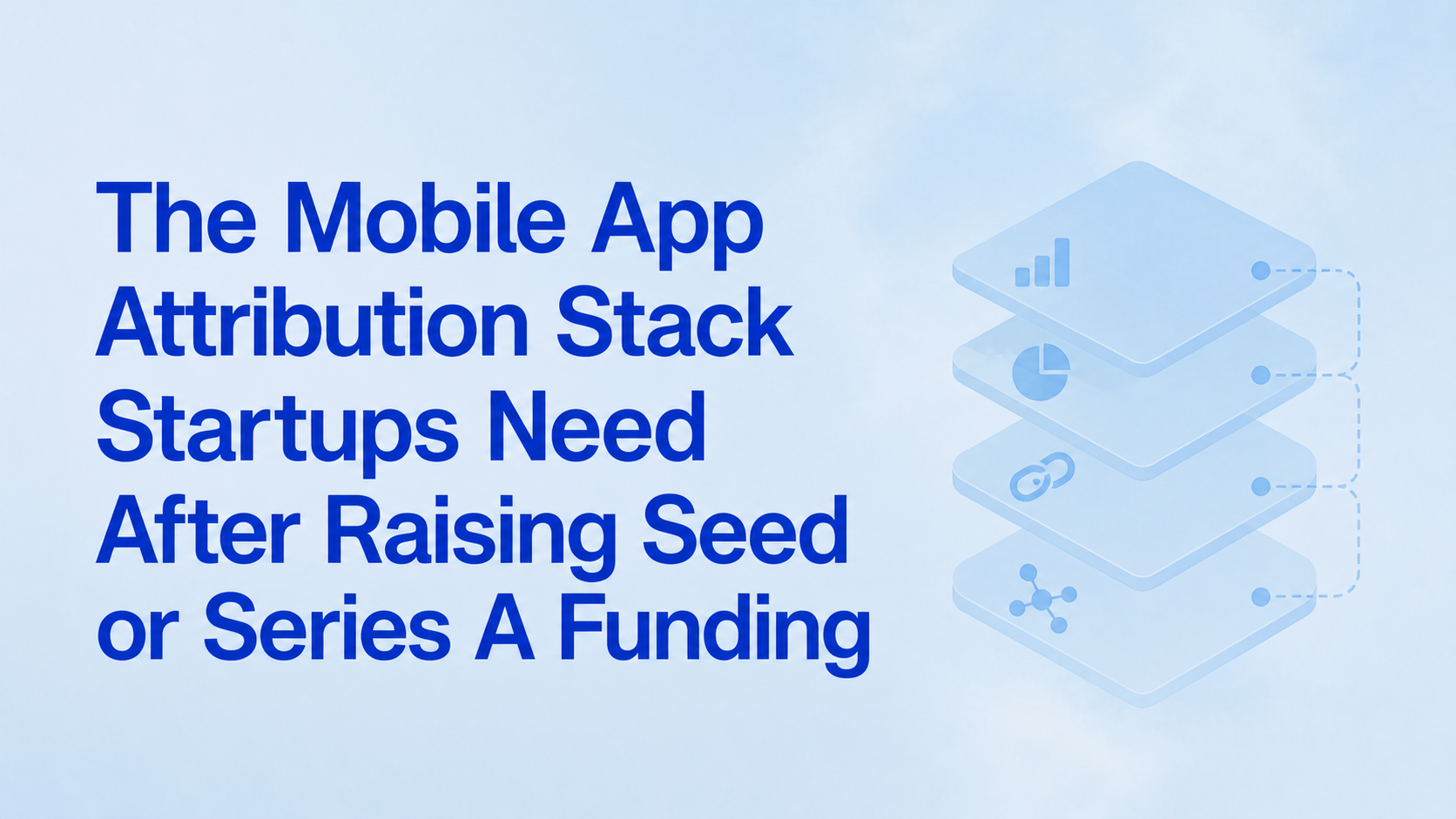
A startup attribution stack has five layers: a Mobile Measurement Partner, deep linking, product analytics, engagement and messaging, and business intelligence. The order you build them in matters as much as the tools you choose.
The layers, and what each one owns:
- Mobile Measurement Partner (MMP)****: the neutral referee that attributes installs and in-app events to the channel that drove them, and deduplicates across self-attributing networks.
- Deep linking: routes users to the right in-app screen from any link, and preserves that routing through an install so campaigns and referrals resolve correctly.
- Product analytics: behavioural depth once the user is inside the app (funnels, feature usage, session flows).
- Engagement and messaging: push, in-app messages, and lifecycle campaigns that act on the events the stack captures.
- Business intelligence: the warehouse and dashboards where marketing, revenue, and finance data finally meet. The build order is deliberate. The MMP and deep linking come first because they define the truth every other layer inherits. If you bolt product analytics and BI on top of unreliable attribution, you have built dashboards on sand.
Layer One: Why the MMP Comes First, Not Last
Most teams reach for product analytics first, because it is familiar and often free to start. That is the wrong sequence. Without an MMP sitting between your ad networks and your app, you have no neutral source of truth, and every channel's self-reported number goes unchallenged.
Why the MMP is the foundation, not the finish:
- It deduplicates. When Meta and Google both claim the same install, the MMP decides who actually earned it. Nothing else in the stack can.
- It standardises events. One event taxonomy flows to every channel and every downstream tool, instead of each platform defining "purchase" its own way.
- It powers value-based optimisation. By sending revenue-bearing postbacks to the ad networks, the MMP lets you optimise toward paying users rather than cheap installs. The historical objection was that an MMP was slow and expensive to add, so teams delayed it. That is no longer true. An SDK integration now runs in the region of two to four hours, and first data can land within a day, which means the MMP layer no longer blocks the rest of the stack. If you are still deciding whether you have crossed the threshold that warrants one, our guide on when to adopt an MMP lays out the budget and scale benchmarks.
Connecting Product Analytics and Engagement Tools to Attribution Data
Once the MMP owns the source of truth, the value comes from feeding that truth into the tools your team already lives in. Attribution data is only powerful when your analytics and messaging layers share the same event definitions.
How the layers connect in practice:
- Product analytics (Mixpanel, Amplitude, PostHog, or GA4) receives the same events the MMP captures, so a funnel in your analytics tool and a cohort in your attribution dashboard describe the same users.
- Engagement platforms (MoEngage, CleverTap, WebEngage, Braze) act on attribution events to trigger lifecycle campaigns, and their re-engagement can be attributed back rather than lost to organic.
- Deep linking ties it together, so a push notification or a referral routes to the correct screen and the resulting action is credited correctly. Deferred deep linking ensures this survives the install step. The failure mode to avoid is a stack where each tool defines events differently. When that happens, marketing, product, and finance argue about whose number is right instead of acting on any of them. A shortlist of the tools worth connecting is in our rundown of the best tools to stack with your MMP.
What to Set Up in the First Two Weeks
The first two weeks after you turn on paid spend decide whether your reporting is trustworthy for the next year. Sequence the work, assign owners, and define what "done" means for each task.
A realistic two-week sequence:
- Days 1-3: MMP and SDK. Install the SDK, confirm install attribution fires for organic and paid, connect the first ad networks. Owner: engineering, with marketing signing off on the channel list. The Linkrunner quickstart is a representative example of the setup path.
- Days 3-6: event taxonomy and revenue events. Instrument activation, key conversion, and revenue events with values attached. Owner: product and engineering; marketing defines which events matter.
- Days 6-9: deep linking and postbacks. Configure deferred deep links and value-based postbacks to each channel. Owner: engineering; marketing validates the routing.
- Days 9-12: dashboards and downstream tools. Connect product analytics, engagement, and BI to the same event stream. Owner: growth or analytics.
- Days 12-14: QA and acceptance. Test installs, events, revenue, and deep links across devices before scaling spend. Owner: whoever will be blamed if the Monday report is wrong. The acceptance check for the whole fortnight is simple: can you produce cost per paying user by channel, and does it reconcile within a tolerance you can defend to the board?
Stack Mistakes Funded Startups Make
Across post-funding attribution audits, the same three mistakes recur, and all of them cost money that the fresh raise was supposed to deploy efficiently.
-
Buying enterprise tooling too early. A newly funded team signs a legacy MMP on an annual contract with seat limits and feature paywalls, then spends onboarding weeks before a single campaign is measured. The tooling outgrows the team's needs in the wrong direction.
-
Staying GA4-only. The most common pattern we see is a team that scales spend to several channels while still treating GA4 as the source of truth, then cannot explain why channel numbers never reconcile. GA4 measures behaviour well and cross-network install attribution poorly.
-
Buying before designing events. Teams purchase tools before deciding what to measure, so they instrument whatever is default and discover months later that revenue was never captured with values attached. Two more patterns are worth naming because they waste the raise quietly:
-
Hiring the stack before designing it. A new growth hire arrives and rebuilds measurement around whatever tools they used last, rather than around the questions this business needs answered. Design the measurement plan first, then let the hire execute it.
-
Optimising channels on installs, not revenue. Even with an MMP in place, teams often leave campaigns optimising toward installs because it is the default. That buys volume the board mistakes for progress. Point optimisation at revenue-bearing events as soon as you have enough of them to bid on. The through-line is sequencing. Fund the decision, not the logo. Design the event model, choose the neutral referee, then add depth. A stack assembled in that order stays honest as you scale, which is the entire point of the exercise laid out in our guide to scaling app campaigns from ₹5 lakh to ₹50 lakh a month.
What the Stack Should Cost at Your Scale
The stack does not have to be expensive to be correct. Cost should track your install volume, not a sales team's target.
A sane cost frame for a funded startup:
- MMP: the layer teams most often overpay for. Legacy MMPs commonly run ₹3 to ₹8 lakh a month at around 100,000 installs. Usage-based pricing, which charges per attributed install rather than per seat, keeps this proportional as you grow. Between roughly 20,000 and 100,000 monthly installs, usage-based pricing typically comes in well below legacy per-seat models.
- Product analytics: generous free tiers cover early scale; you pay as event volume grows.
- Engagement: priced on monthly active users; start with what your lifecycle programme actually uses.
- BI: warehouse plus a dashboarding tool, largely usage-priced. The cost sanity check is to compare a per-seat, feature-paywalled model against a usage-based one at your real install volume. At 20,000 to 100,000 installs a month, the difference over a year is frequently the price of an additional hire. Track the whole stack against ROAS so tooling cost stays a visible line, not a hidden one, and use cohort analysis to confirm the paying users justify the spend. The metrics worth holding the stack accountable to are in our list of the mobile marketing metrics that actually predict startup success.
How to Validate the Stack in Week One of Spend
A stack is only as good as its first reconciliation. In the first week of paid spend, prove the layers agree before you scale the budget, because a stack that cannot reconcile at ₹40 lakh will not magically reconcile at ₹4 crore.
- Reconcile installs three ways. Compare MMP installs against each ad network's reported installs and against your app store console. Expect the MMP to be lower than the summed network numbers, because it deduplicates. If it is higher, something is double-counting.
- Reconcile revenue two ways. Compare MMP revenue events against your payment gateway or billing provider. A widening gap means a broken or unvalued revenue event, which is the most expensive silent failure in the stack.
- Confirm the event taxonomy is shared. Check that a funnel in your product analytics tool and a cohort in your attribution dashboard describe the same users with the same event names. Divergence here is what starts the "whose number is right" argument.
- Verify postbacks optimise on the right event. Confirm the ad networks are receiving your revenue-bearing events, not just installs, so bidding trains toward paying users from the first week. Tech Explainer: why channel numbers never sum to reality. Self-attributing networks like Meta and Google each attribute an install if they touched the user, using their own last-touch logic inside their own walled garden. When a user saw a Meta ad and then clicked a Google ad, both can claim the install. Add them up and you get more installs than your app store recorded. The MMP sits outside all of them, applies one consistent last-touch attribution rule across every channel, and deduplicates. That neutral referee role is precisely why the layer cannot be replaced by any single channel's dashboard or by product analytics.
The acceptance test for week one is unchanged from the two-week plan: can you produce cost per paying user by channel, and does it reconcile within a tolerance you can defend to the board. If yes, scale. If no, fix the layer that is lying before you add a rupee.
Frequently Asked Questions
Do we need an MMP at seed stage?
If you are spending on paid acquisition across more than one channel, yes. The moment two ad networks can both claim the same install, you need a neutral referee to deduplicate, and no product analytics tool does that job. If you are still purely organic, an MMP can wait until you turn on spend.
Can Firebase be the whole stack?
No. Firebase and GA4 measure in-app behaviour well but handle cross-network install attribution and deduplication poorly, because Google Analytics was not built to referee competing ad networks. Most funded teams run Firebase for product analytics and an MMP for attribution, connected through a shared event taxonomy.
How long does setup take?
The technical work is short: an SDK integration runs in the region of two to four hours, and first data can arrive within a day. The two-week timeline in this guide exists because event design, deep linking, and QA, not the SDK, are what actually determine whether your numbers are trustworthy.
Building the Stack Before You Scale the Spend
The teams that waste their raise are not the ones that pick the wrong tool. They are the ones that scale spend before the measurement stack can keep up, then spend their first funded quarter reconciling numbers instead of optimising them. Build the five layers in order, put the neutral referee first, design the events before you buy the tools, and hold the whole stack to cost per paying user by channel.
If you want the MMP and deep linking layers live in a day rather than a month, so testing starts in week one instead of month two, that unified approach is exactly what platforms like Linkrunner are built for, and you can request a demo from Linkrunner to see it against your own channels. Start by writing down your five layers and their owners, then run the two-week setup sequence before you turn the budget up.