
Two teams start the same festive campaign. One begins in August with a budget envelope, a walk-away number and a frozen measurement setup. The other begins in early October, briefing creative while CPMs are already climbing.
By Diwali week the first team is scaling the two things that survived testing. The second is testing at peak prices, which is the most expensive possible time to learn something.
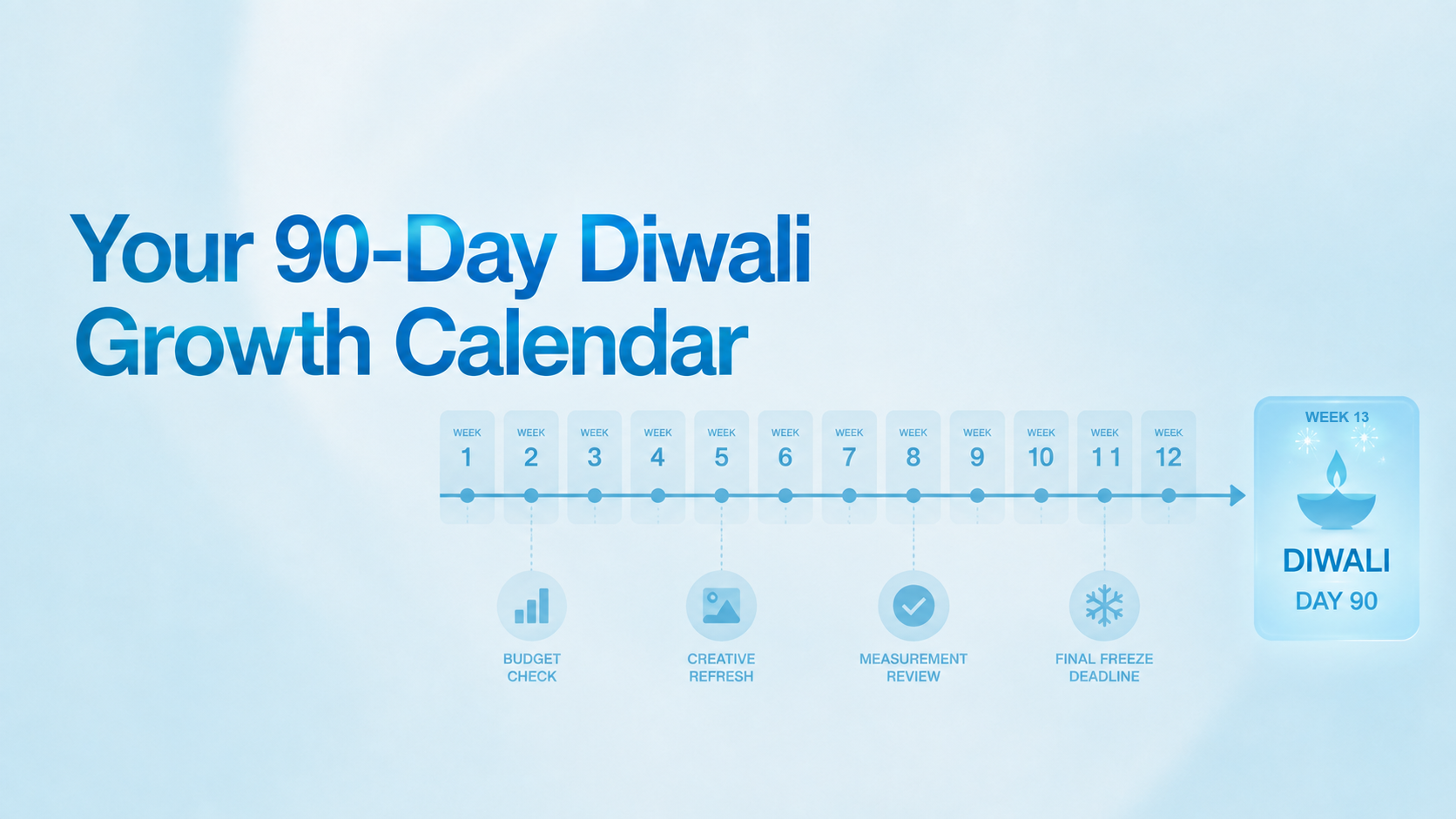
Diwali 2026 falls on Sunday 8 November. This is the sequence for the 90 days before it.
The dates that actually matter this year
A festive marketing calendar is a working-backwards plan that sequences budget, creative, measurement and freeze deadlines against a fixed festival date, so decisions requiring lead time get made before auction costs rise rather than during.
| Date | What it means for spend | Event |
|---|---|---|
| ~23 Sept to 2 Oct | First spend wave. Amazon's Great Indian Festival overlaps | Flipkart Big Billion Days |
| Mid to late Oct | Second wave, softer but sustained | Navratri and Dussehra |
| Fri 6 Nov | Peak transaction volume for commerce and fintech | Dhanteras |
| Sun 8 Nov | Most expensive inventory of the year | Diwali |
| Tue 10 Nov | Window closes | Bhai Dooj |
Three waves, not one. This matters more than any other planning fact, because a team planning for a single November peak arrives six weeks late to an auction that has already repriced.
Days 90 to 60: decide and build
Roughly 10 August to 9 September. This is where the campaign is actually won.
-
Agree the budget envelope and the walk-away number. Not a target cost per install. The maximum cost per activated user you will tolerate, signed off by whoever owns the budget. Decide it now, because during festive nobody has time to negotiate and it gets set by whoever is most optimistic at 11pm.
-
Make the vertical call. Bid through the peak, bid the shoulders, or sit out. Commerce, quick commerce, payments, gifting, travel and gaming top-ups have real festive demand. Content, social and edtech usually see moderate lift and do better buying the weeks either side. If festive drives no demand for your category, spending your annual peak budget in your least efficient month is a choice, not an obligation.
-
Capture your baseline. Current install volume, activation rate, and cost per activated user by channel. Three numbers, one document, this week. Without them every festive figure in November is uninterpretable.
-
Verify and freeze measurement. Postback mapping per network, deep link QA, revenue event testing, fraud thresholds, alerting. This has its own checklist and it needs to be done by mid September.
-
Brief creative concepts. Do not produce yet. Briefing is a 90-day task. Production is a 60-day task. Reversing them means producing against a strategy that has not been agreed.
The budget allocation framework for multi-channel app growth is the right starting point for the envelope conversation, and the deep link QA checklist covers the routing surfaces before new festive landing pages exist.
Days 60 to 30: test cheaply
Roughly 9 September to 9 October. Inventory is still affordable. Use it.
-
Run your creative tests now. Every concept you plan to scale should have been validated before the auction reprices. Testing in Diwali week costs several times what the same test costs in September and teaches you the same thing. A five-day creative testing sprint fits three full rounds into this window.
-
Big Billion Days is your live rehearsal. From roughly 23 September, the first wave hits. Treat it as a dress rehearsal for Diwali: watch how your costs and activation rates respond, and you will know six weeks early whether your assumptions hold.
-
Lock the measurement freeze by mid September. After this point, no SDK updates, no event renames, no conversion value changes, no attribution window edits. The rule is simple: never change how you measure while you are changing how much you spend.
-
Set your scaling rules in writing. What has to be true for you to double a budget? What has to be true for you to cut one? Agreeing this in September prevents improvisation at peak CPM in November.
Days 30 to 7: scale what worked
Roughly 9 October to 1 November. Execution, not discovery.
-
Scale only what passed testing. The temptation to introduce a new concept because the tested ones feel stale is strong and almost always wrong. Creative fatigue is real, which is why you tested several concepts, not one. Our guide to creative fatigue and refresh cycles covers rotating within a validated set.
-
Second wave: Navratri and Dussehra. Mid to late October. Softer than Big Billion Days but sustained, and a useful check on whether your Diwali-week assumptions still hold.
-
Release budget tranche by tranche. Reserve-and-release rather than front-loading. Each tranche unlocks against the previous wave's activation numbers, not against optimism.
-
Hold 15 to 20 per cent unallocated. This reserve is what lets you scale the one thing that is working on 7 November instead of watching it hit its cap.
The final week: execute and watch
2 to 10 November. Dhanteras on the 6th, Diwali on the 8th, Bhai Dooj on the 10th.
Daily checks only. Three numbers, five minutes each morning:
-
Installs against yesterday and against the same day last week
-
Activation rate, your earliest signal that traffic quality or tracking has changed
-
Network-reported conversions against MMP-reported conversions, watching whether the gap is stable
No structural changes. Not to campaigns, not to measurement, not to the app.
When cost per action spikes on Diwali day itself, and it will, the question is whether your activation rate held. If activation is stable and only cost rose, that is the auction and it is temporary. If activation fell alongside cost, you are buying worse traffic and should throttle rather than push. The Monday morning performance marketing routine compresses well into a daily version for this week.
Days 1 to 30 after: the part everyone skips
11 November to mid December. This is where next year's advantage is created.
-
Watch retention on festive cohorts. Festive-acquired users usually retain worse than your baseline. That shows up in December and January, never in your November dashboard. If you judge the campaign on install volume alone you will repeat an expensive mistake. Attribution data can drive retention marketing directly here.
-
Wait 14 days before reconciling. Late postbacks and delayed revenue events keep arriving. Reconciling on 11 November produces numbers you will only have to redo.
-
Write the handover document while you remember. What broke, what you changed mid-window and when, which decisions you made on incomplete data, and what you wish you had set up in September. One page. It is worth more to next year's team than the campaign report.
Cohort tagging by festive week is what makes this possible, and it only works if you set it up before the window opens. Retrospectively reconstructing which users arrived in which wave means exporting raw data in December, which is how this task quietly never happens. Holding installs, activation events and revenue together by cohort is the difference between planning next year from evidence and planning it from memory.
Start with the three numbers
If you do nothing else this week, write down your current install volume, activation rate and cost per activated user by channel.
Everything in this calendar is a comparison against those three numbers. Without them you will spend the festive window guessing whether things are going well.
If you want to see those cuts on your own data before the window opens, request a demo and we will walk through them.
FAQ
When is Diwali in 2026?
Diwali falls on Sunday 8 November 2026. Dhanteras is Friday 6 November and Bhai Dooj is Tuesday 10 November. The wider festive advertising window opens far earlier, from roughly 23 September with Flipkart Big Billion Days.
How early should app teams start festive campaign planning?
Around 90 days out, which for 2026 means early to mid August. Budget envelopes, vertical decisions and measurement freezes all need lead time, and creative has to be tested while inventory is still affordable rather than during the peak.
Is it too late to plan a festive campaign in October?
Not too late, but the plan changes. With 30 days left, skip discovery entirely: run what you already know works, do not attempt creative testing at peak prices, keep measurement frozen exactly as it is, and hold a larger reserve than usual because you have less evidence to act on.
Does the festive calendar differ for non-shopping apps?
The dates are the same but the decision is different. Apps without genuine festive demand still pay the higher auction prices without receiving the demand lift, so bidding the shoulder weeks either side of the sale events, or redirecting budget to a quieter month, is often the better return.
What should happen in the month after Diwali?
Watch retention on festive-acquired cohorts, wait at least 14 days before reconciling numbers so late postbacks land, and write a one-page handover covering what broke and what you would set up differently. The post-window month is where the compounding advantage is built.