
You're spending ₹15 lakh a month across Meta, Google, and TikTok. Your Meta ROAS is 2.8x. Google is showing 1.9x. TikTok reports 3.1x. So you shift 40% of your Google budget to TikTok because the numbers say it's working better. Two weeks later, your overall ROAS drops by 22% and installs from Google collapse. What happened?
You fell into the most common budget allocation trap in mobile marketing: treating channel ROAS as an isolated number instead of understanding how channels work together. The reality is that Google often assists conversions that Meta or TikTok ultimately get credit for. When you cut Google, you didn't just lose Google installs. You lost the search intent that was feeding your other channels.
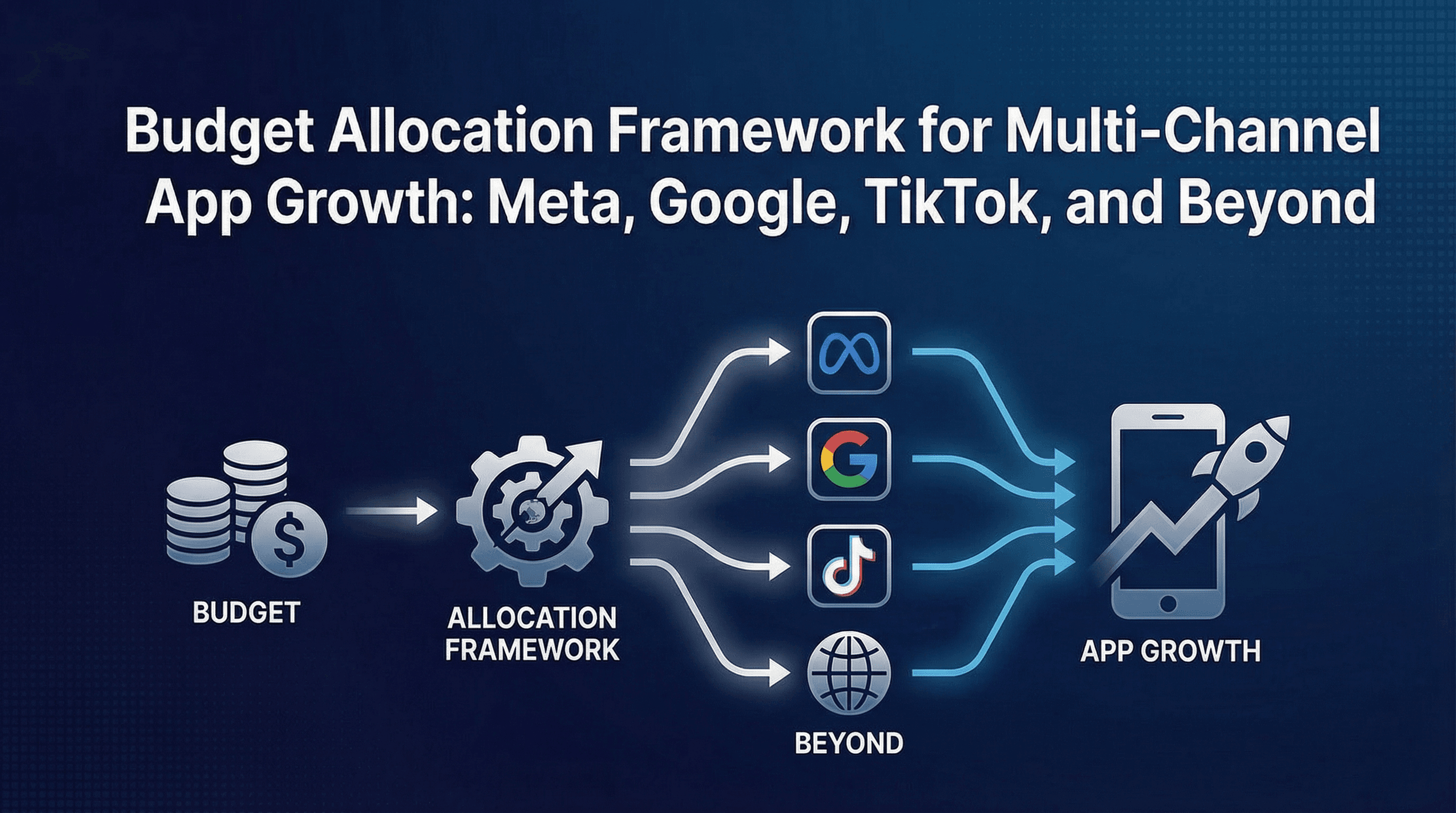
This guide provides a systematic framework for allocating and rebalancing your app marketing budget across channels. It's built for teams spending ₹5-50 lakh monthly who need a repeatable process, not gut decisions.
The Multi-Channel Budget Allocation Problem: Beyond "Spend More on What Works"
The instinct is natural. You check your MMP dashboard, see which channels have the best ROAS, and move money toward the winners. On paper, this makes sense. In practice, it breaks in three ways.
First, each channel has diminishing returns at different thresholds. Meta might deliver ₹180 CPI at ₹5 lakh monthly spend but ₹320 CPI at ₹15 lakh. The "best" channel at one budget level becomes the worst at another. Second, channels have interdependencies. A user who sees your TikTok ad might search your brand on Google and install from there. Your MMP credits Google, but TikTok did the awareness work. Third, different channels serve different funnel stages. Cutting an upper-funnel channel based on last-click ROAS starves your lower-funnel channels of qualified traffic.
For a deeper understanding of how different attribution approaches handle these cross-channel dynamics, see best 6 attribution models for different mobile app verticals.
Why Simple ROAS-Based Allocation Breaks at Scale
Simple ROAS-based allocation assumes each channel operates independently. It treats your budget as a zero-sum game where every rupee moved from Channel A to Channel B produces the same return at the new allocation.
This assumption fails because of three forces.
Audience saturation means that each additional rupee spent on a channel reaches increasingly marginal users. The first ₹3 lakh on Meta targets your warmest lookalike audiences. The next ₹3 lakh reaches colder segments. By ₹15 lakh, you're in broad targeting territory with fundamentally different economics.
Learning phase resets compound the problem. When you make large budget shifts (more than 20-30% in a single week), ad platform algorithms lose their optimisation signal. Meta's Advantage+ campaigns, Google's UAC, and TikTok's Smart Campaigns all need stable budgets to learn which users convert. Large swings reset this learning, temporarily inflating your CPI while the algorithm readjusts.
Channel interaction effects are the hardest to measure but often the most significant. Across attribution audits we've run for mid-scale consumer apps, we consistently find that 15-25% of installs attributed to branded search or direct channels were actually initiated by paid social or video ads. Cutting the initiating channel doesn't just remove its direct installs; it reduces the pipeline feeding your other channels.
The Budget Allocation Framework: 4 Core Principles
This framework replaces gut-feel allocation with a structured approach that accounts for diminishing returns, channel interdependencies, and learning requirements.
Principle 1: Start with Incremental Contribution, Not Absolute ROAS
Absolute ROAS tells you how much revenue a channel generated per rupee spent. Incremental contribution tells you how much additional revenue that channel generated that wouldn't have happened otherwise.
The difference matters. Your branded search campaign might show 8x ROAS, but 70% of those users would have installed organically anyway. Your TikTok campaign might show 1.8x ROAS, but every single install is genuinely incremental because those users had never heard of your app.
To estimate incremental contribution, run simple holdout tests. Pause a channel in one geo for 7-10 days while keeping it active in a comparable geo. Compare total installs (not just attributed installs) across both geos. The difference is your incremental contribution estimate.
Principle 2: Reserve 10-15% of Budget for Discovery and Testing
Allocating 100% of your budget to proven channels feels efficient. It's actually a trap. Without a testing budget, you never discover new channels or audiences that could outperform your current mix. You also become increasingly dependent on one or two channels, which makes you vulnerable to platform changes, CPM spikes, or algorithm shifts.
Reserve 10-15% of your monthly budget for testing. This covers new channel trials (Apple Search Ads, influencer, affiliate, OEM), new audience segments on existing channels, and creative format experiments. The testing budget has different success criteria than your core budget. Core budget optimises for ROAS. Testing budget optimises for learning velocity.
Principle 3: Account for Channel Velocity and Learning Time
Different channels produce results at different speeds. Meta typically shows reliable signal within 3-5 days. Google UAC needs 7-14 days to exit its learning phase. TikTok falls somewhere in between. Apple Search Ads can show signal within 24-48 hours for high-volume keywords.
This means your rebalancing cadence should match channel velocity. Don't compare a 3-day-old TikTok campaign against a 14-day Meta campaign. Wait until both have comparable data maturity before making allocation decisions.
Principle 4: Balance Short-Term Performance with Long-Term Strategic Goals
Pure performance allocation ignores strategic considerations. You might want to build presence on TikTok because your competitors aren't there yet, even if the short-term ROAS is lower than Meta. You might invest in Apple Search Ads brand defence even though the ROAS looks inflated because the alternative is competitors capturing your brand traffic.
Allocate 70-80% of your budget based on performance data. Allocate 10-15% for testing (Principle 2). Reserve 5-15% for strategic bets that serve longer-term goals.
Initial Allocation Model: How to Distribute Your First ₹10L
If you're starting multi-channel UA or restructuring your allocation, use this as a baseline model for ₹10 lakh monthly spend.
Meta (40-50%, ₹4-5L). Meta remains the highest-volume, most predictable channel for most app categories in India. Start with lookalike audiences based on your highest-value users. Allocate 60% to prospecting and 40% to retargeting. Use Advantage+ campaigns for broad prospecting once you have 50+ conversions per week.
Google UAC (25-30%, ₹2.5-3L). Google captures high-intent users through search and reaches massive scale through Display and YouTube. Set up separate campaigns for installs and in-app events. Prioritise event-optimised campaigns once you have enough conversion volume (10+ events per day per campaign).
TikTok (10-15%, ₹1-1.5L). TikTok is typically a discovery channel with lower intent but strong creative-driven performance. Start with smaller budgets and scale based on creative winners. TikTok's audience skews younger, so adjust LTV expectations accordingly for your vertical.
Testing/emerging channels (10-15%, ₹1-1.5L). Rotate through Apple Search Ads, influencer campaigns, affiliate partnerships, or OEM pre-installs depending on your vertical and audience.
This is a starting framework. Your optimal allocation depends on your vertical, audience demographics, and product. For a comprehensive view of which metrics to monitor as you test these allocations, see daily, weekly, monthly KPIs: what to track and when for mobile marketers.
Performance-Based Rebalancing: When and How to Shift Budget
Rebalancing is where most teams go wrong. They either rebalance too aggressively (large swings that reset learning phases) or too slowly (waiting 30 days when signal was clear after 10). Here's a structured approach.
Weekly micro-adjustments (5-10% shifts). Every week, review channel-level CPI and ROAS. If a channel has consistently outperformed for 2+ weeks, shift 5-10% of your lowest performer's budget toward it. Small, consistent shifts avoid learning phase resets while gradually optimising your mix.
Bi-weekly rebalancing reviews. Every two weeks, conduct a deeper review. Look at cohort-level data (D7 ROAS by channel, not just D0). Compare incremental CPI trends. Check frequency and reach metrics for saturation signals. Make larger adjustments (10-20%) if data strongly supports it.
Monthly strategic reviews. Once a month, step back from performance data and assess strategic allocation. Is your testing budget producing learnings? Are your strategic bets showing early signal? Should you reallocate between categories (prospecting vs retargeting vs testing)?
Rebalancing triggers. Beyond scheduled reviews, these signals should trigger immediate investigation: CPI increases of more than 25% week-over-week on a stable campaign, ROAS drops of more than 30% without creative changes, frequency exceeding 4-5 on Meta prospecting campaigns, and conversion volume dropping below learning phase minimums.
Channel-Specific Allocation Strategies
Meta allocation by campaign type. Split your Meta budget into three buckets: 50-60% for prospecting (lookalikes and broad), 20-30% for retargeting (app openers, cart abandoners, lapsed users), and 10-20% for testing (new audiences, creative formats, Advantage+ experiments).
Google UAC allocation by campaign goal. Run separate campaigns for install volume (tCPI bidding) and event optimisation (tCPA bidding). Allocate 40% to install campaigns for scale and 60% to event campaigns for quality. As your conversion volume grows, shift more toward event-optimised campaigns.
TikTok allocation by creative. TikTok performance is almost entirely creative-driven. Allocate 70% of your TikTok budget to your top 2-3 performing creatives and 30% to testing new concepts. Rotate creatives more aggressively than on Meta because TikTok creative fatigue sets in faster (typically 10-14 days vs 21-28 on Meta).
The Holdout Test: Validating Incremental Contribution
Holdout tests are the only reliable way to measure whether a channel is truly driving incremental results or simply claiming credit for conversions that would have happened anyway.
Here's the practical approach. Pick a channel you want to validate. Identify two comparable geographic regions (similar population, similar app adoption, similar baseline organic installs). Pause the channel in Region A. Keep it running in Region B. Run the test for 7-14 days. Compare total installs (organic plus paid) across both regions.
If Region B's total installs exceed Region A by approximately the attributed install volume, your channel is genuinely incremental. If Region B's installs exceed Region A by significantly less than attributed volume, some of your attributed installs are cannibalising organic. If there's no meaningful difference, the channel isn't providing incremental value and your budget is better spent elsewhere.
Run holdout tests quarterly for your top 2-3 channels. The results should directly inform your allocation percentages.
Monthly Budget Review Framework: What to Analyse and When to Act
Your monthly budget review should follow this sequence.
Step 1: Pull channel-level economics. For each channel, document: total spend, installs, CPI, D7 ROAS (cohorted), D30 ROAS (if available), frequency, and reach. Compare against the previous month.
Step 2: Identify saturation signals. Look for rising CPI with stable or declining reach. This indicates audience exhaustion. If Meta CPI has increased 15%+ over the month while reach has plateaued, you're likely saturating your current audiences.
Step 3: Review testing budget outcomes. What did you test this month? What worked? What didn't? How should next month's testing budget be allocated based on these learnings?
Step 4: Propose next month's allocation. Based on performance trends, saturation signals, and strategic priorities, propose specific budget numbers for each channel. Document the rationale for any shifts greater than 10%.
Step 5: Set trigger thresholds. Define the performance thresholds that would trigger mid-month rebalancing. This prevents reactive decision-making while ensuring you catch genuine performance shifts early.
For teams looking to reduce CAC while maintaining these allocation principles, see 8 smart ways to reduce mobile app CAC without cutting quality for complementary optimisation strategies.
Implementation Playbook: Setting Up Channel Performance Tracking in Week One
Before you can allocate budget intelligently, you need clean, comparable data across all channels. Here's how to set this up in your first week.
Day 1-2: Standardise attribution windows. Set consistent attribution windows across all channels. A common starting point is 7-day click-through and 1-day view-through. Don't compare Meta with a 28-day window against Google with a 7-day window.
Day 3-4: Set up unified reporting. Create a single dashboard (or spreadsheet, if that's where you are today) that shows all channels side by side with consistent metrics. At minimum, track spend, installs, CPI, and ROAS per channel per week.
Day 5: Define your rebalancing cadence. Based on your total budget, set a schedule. Teams spending ₹5-10L monthly should do bi-weekly reviews. Teams spending ₹15L+ should do weekly reviews. Teams spending ₹30L+ should consider daily monitoring with weekly decision points.
Day 6-7: Document your allocation rationale. Write down why each channel gets its current percentage. This becomes your baseline for future reviews and prevents emotional rebalancing during performance dips.
Platforms like Linkrunner consolidate attribution data from Meta, Google, TikTok, and other channels into a single dashboard with consistent attribution windows, making it straightforward to compare channel economics without reconciling numbers across multiple platforms.
FAQ: Budget Allocation Questions Answered
How often should I change my budget allocation?
Make micro-adjustments (5-10%) weekly. Conduct structured rebalancing reviews bi-weekly or monthly depending on spend level. Avoid making large allocation changes (more than 20%) more than once per month unless there's a clear performance crisis.
Should I allocate budget based on D0 CPI or D7 ROAS?
Always prioritise D7 ROAS (or later, if you have the data) over D0 CPI. A channel with higher CPI but better downstream ROAS is almost always a better investment. CPI alone tells you nothing about user quality.
What percentage of budget should go to a new channel?
Start at 5-10% of your total budget for any new channel. Run it for 2-4 weeks with this allocation before making scale-up decisions. This gives you enough data to evaluate without risking significant budget on unproven performance.
How do I handle seasonal budget allocation?
Build a seasonal adjustment calendar based on your vertical's patterns. eCommerce apps should increase budget 30-50% during festive seasons (Diwali, end-of-year sales). Gaming apps typically see lower CPI during holidays when screen time increases. Plan these shifts 2-3 weeks in advance so algorithms have time to adjust.
When should I stop investing in a channel entirely?
Consider pausing a channel if it consistently delivers negative incremental ROAS (below 1.0x on D30 cohorts) for 4+ consecutive weeks after optimisation attempts. Run a holdout test before fully pausing to confirm the channel isn't providing hidden value through assist effects.
Making Budget Allocation a Repeatable System
The biggest mistake in multi-channel budget allocation isn't choosing the wrong percentages. It's treating allocation as a one-time decision instead of a continuous optimisation process. Your optimal channel mix will shift every month as audiences saturate, creative performance changes, and competitive dynamics evolve.
The framework outlined here gives you a structured process for making these shifts based on data rather than intuition. Start with the initial allocation model, run your weekly and monthly reviews, and use holdout tests to validate your biggest assumptions.
The teams that do this well spend 20-30% less per quality install than teams that allocate based on gut feel. The difference isn't in picking the "right" channels. It's in having a system that catches misallocation early and corrects it before budget compounds in the wrong direction.
If your current setup makes it difficult to compare channel economics in a single view, consider platforms that unify attribution data across networks. Request a demo from Linkrunner to see how unified campaign intelligence simplifies multi-channel budget decisions.