
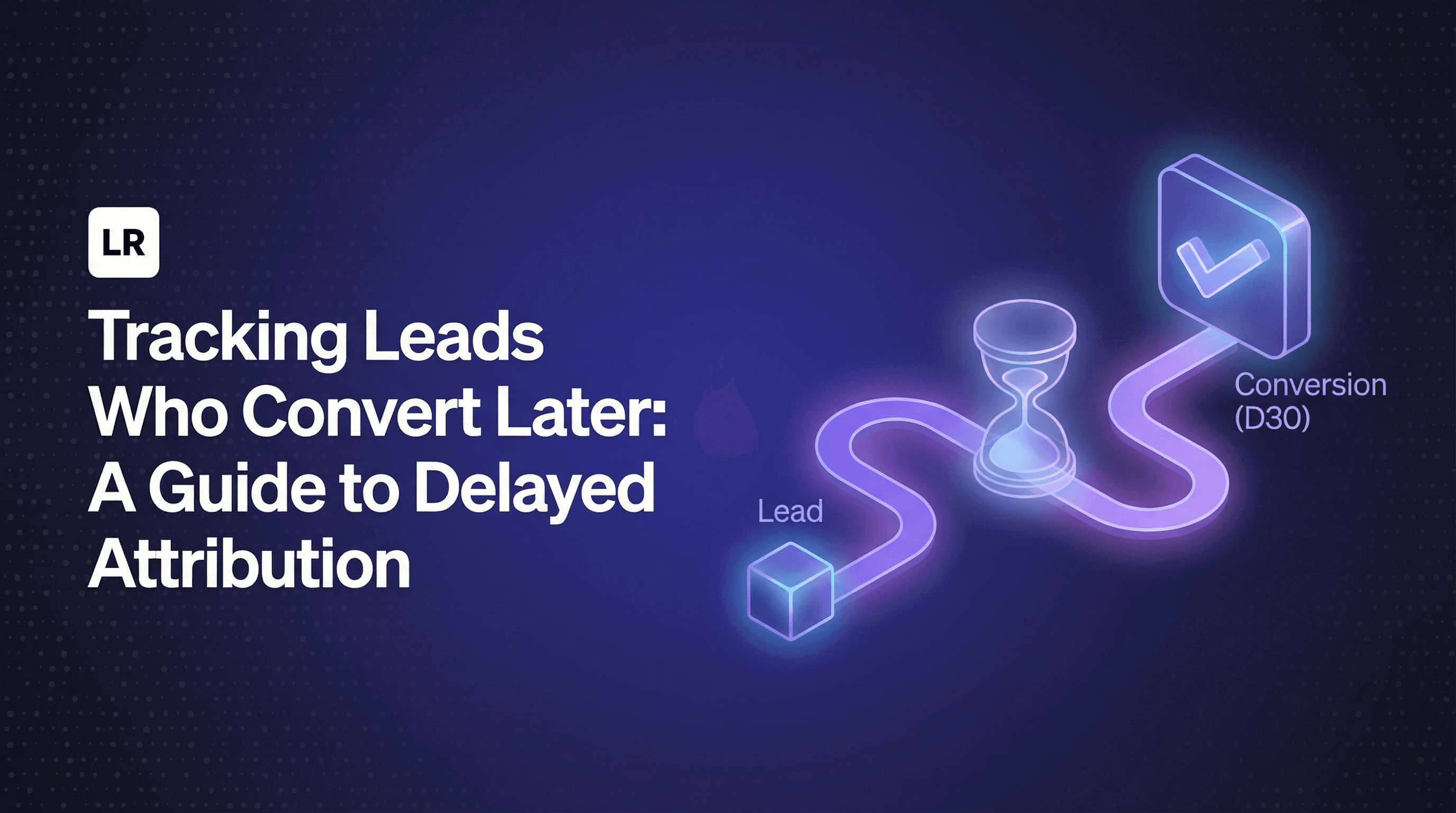
A question on r/marketing recently got marketers talking: how to track leads who convert later? The thread surfaced several practical takes, but the topic deserves a deeper look. Here is what the thread missed.
Community Spotlight
This post was inspired by a discussion on Reddit: How to track leads who convert later?
Posted in r/marketing
The core challenge discussed in the Reddit post is the difficulty of connecting a top-of-funnel interaction to a bottom-of-funnel conversion that happens significantly later. Several commenters pointed out that this is a classic problem in B2B and high-consideration B2C apps, where the user journey is rarely linear.
The Problem of Delayed Conversions
When a user clicks an ad, downloads an app, and then waits a week to make a purchase, traditional last-click models often struggle to accurately attribute that revenue to the initial ad. This creates a disconnect between user acquisition spend and downstream revenue.
Marketers need to map the entire user journey, not just the final step.
This requires robust tracking that can connect the initial install event to subsequent in-app actions over time.
The delay in conversion signals makes daily campaign optimisation challenging.
Connecting the Dots Across the Funnel
Many teams discover too late that their MMP charges separately for advanced cohort analysis or restricts the export of raw event data necessary for this kind of long-tail tracking. This lack of transparency forces growth teams to rely on fragmented data and manual spreadsheet calculations.
How a Modern MMP Handles This
A modern MMP would unify deep linking and attribution in a single SDK, route users to the correct in-app destination even through deferred installs, and track user cohorts over time without additional fees. Linkrunner, for instance, does exactly this, offering unrestricted data exports and cohort analysis out of the box, with a flat per-install rate. This allows teams to clearly see the LTV of users acquired through specific channels, regardless of when they convert.
Implementing Long-Term Tracking
To effectively measure the impact of delayed conversions, you need a measurement stack that supports full-funnel visibility.
Ensure your tracking setup captures all relevant in-app events, from registration to purchase.
Utilise cohort analysis to understand how users acquired in a specific timeframe behave over time.
Leverage automated insights to identify trends and anomalies in conversion rates.
The original thread raised a valid point about the complexities of delayed attribution. Here is the actionable version: invest in a platform that provides complete visibility into the user lifecycle.
For teams ready to move beyond fragmented tracking tools, Linkrunner unifies attribution and deep linking at a fraction of the cost. See how it works