
What do you do with your attribution data on Friday afternoon?
For most teams, the answer is nothing. You close the laptops. Monday will bring the weekly review, the "what happened" conversation, the damage assessment. But by then it's too late. The week's budget is spent.
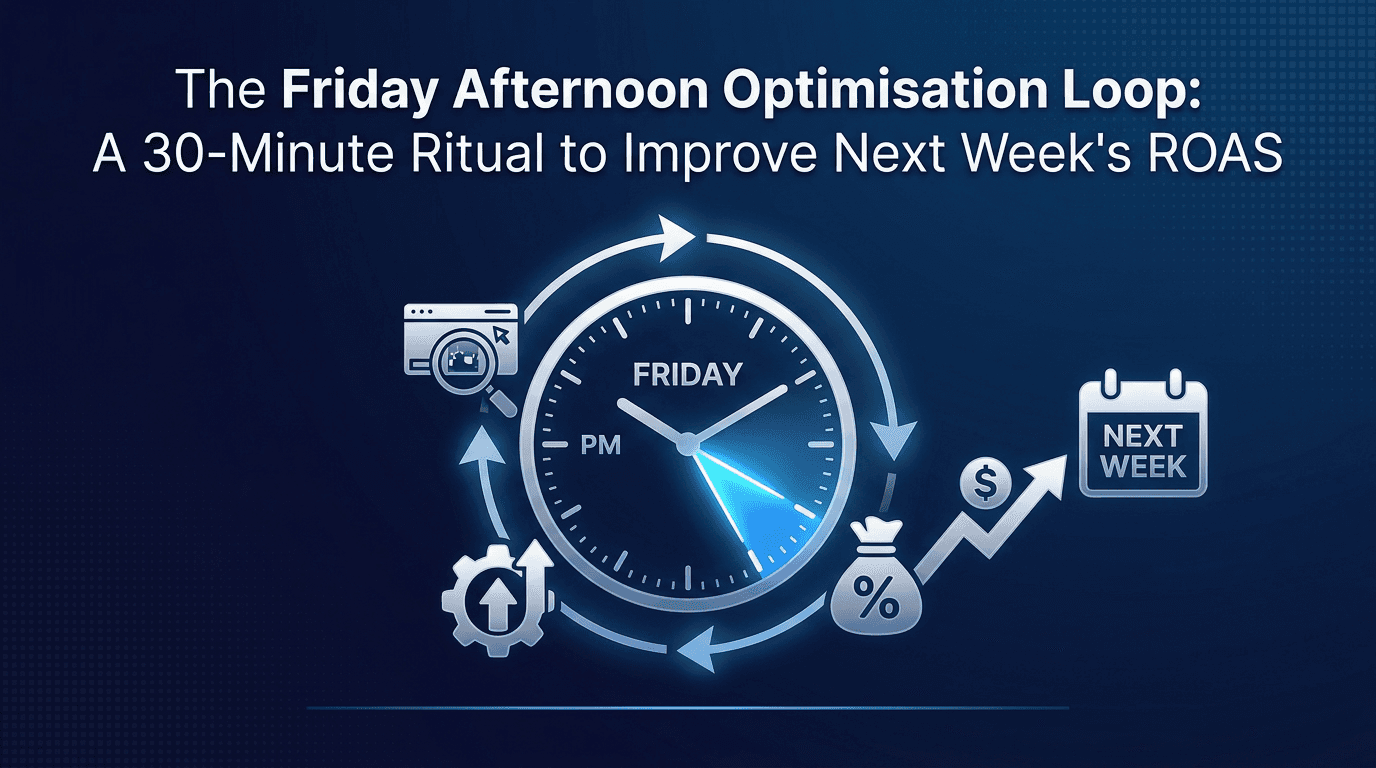
The highest-performing UA teams don't wait for Monday to decide. They close each week with a deliberate 30-minute ritual on Friday: review the week's performance, identify the top three actions for next week, stage those changes, and log the decisions. Monday starts with execution, not analysis.
This is the difference between teams that optimise monthly and teams that optimise continuously. The compounding effect of weekly decisions, executed consistently, is what separates ROAS growth from ROAS stagnation.
This guide will show you exactly how to run the Friday Optimisation Loop. By the end of this week, you'll have a template you can reuse every Friday.
Why Friday Matters More Than Monday for UA Performance
Monday is important. But it's retrospective. You're answering "What happened last week?" You're measuring, analysing, documenting the past.
Friday is where the future gets decided. You're answering "What are we going to do differently next week?" Every decision you make on Friday compounds into the following week's performance. The creative you pause, the budget you reallocate, the ad set you scale. These changes take effect Monday morning, shaping the next seven days of spend.
The Monday Morning Performance Marketing Routine is your backward-looking review. The Friday Loop is your forward-looking action ritual. Teams that do both outperform teams that only do Monday reviews.
The compounding effect is real. A single Friday decision (pause an underperforming campaign) saves you Rs10,000 in wasted spend over the following week. Multiply that by four Fridays in a month, and you've compounded Rs40,000 in recovered budget. That's the difference between flat ROAS and growth ROAS.
The 30-Minute Friday Loop (Step by Step)
The Friday Loop is a five-step decision ritual, not a data reporting exercise. You're not creating a report. You're making decisions that launch Monday morning.
The five steps:
Review the week's performance against targets (3-10 minutes)
Identify the top three actions for next week (3-5 minutes)
Queue changes in your ad platforms (5-8 minutes)
Log decisions and share context (3-5 minutes)
Close out and go home (2-3 minutes)
This is a team activity. Fifteen minutes in, you've already made the critical decisions. The remaining fifteen is execution and communication.
Minutes 1-10: Review the Week's Performance Against Targets
Open your MMP dashboard (or Linkrunner's campaign intelligence dashboard if you're using it) and compare actual numbers to your weekly targets.
What you're checking:
CPI by channel. Did Meta come in at or below target? Did Google drift higher?
ROAS by cohort age. Are D7 ROAS numbers hitting your breakeven threshold?
Install volume. Did you hit volume targets, or are some campaigns underperforming?
Flag campaigns that over-performed or under-performed by more than 15%. These are your candidates for the next step.
The goal here is clarity, not perfection. You're looking for the obvious wins and obvious fails. A campaign that's 3% below target isn't worth discussing. A campaign that's 40% above breakeven ROAS is. A campaign delivering zero installs despite significant spend is.
Spend no more than 10 minutes on this. You're not debugging discrepancies. You're identifying outliers.
Minutes 11-20: Identify the Top 3 Actions for Next Week
Based on what you just reviewed, pick three actions. Only three. More than three and you'll lose focus.
Common actions:
Pause underperforming campaign. A campaign that's consistently delivering CPI 30%+ above target.
Scale winning campaign. A campaign hitting 2.5x+ breakeven ROAS. Can you 2x the budget and hold economics?
Refresh creative. A campaign that's been running for three weeks with no change in creatives. Fatigue signals: CPI rising, ROAS declining despite consistent volume.
Reallocate budget. Move 30% of spend from TikTok to Meta based on week-over-week performance gaps.
Launch new audience test. Expand from lookalikes to a new lookalike pool or interest-based audience.
10 Smart Tactics To Boost ROAS While Keeping CPI Low and How to Build a Creative Performance Dashboard Your Team Will Actually Use both cover tactical decision-making at this stage.
These three actions don't need detailed analysis. "Pause Campaign X because CPI is 40% above target" is enough. You're not writing a case study. You're making a call.
Minutes 21-25: Queue Changes in Your Ad Platforms
Now you move to execution. You don't launch these changes Monday morning. You queue them Friday so Monday is a single-click activation.
For each action:
Pause campaign: Set the campaign to pause effective Monday at 00:00 (your timezone).
Scale budget: Create a new budget allocation in the campaign settings. Set it to take effect Monday.
Launch new creative: Upload the new ad, associate it with the ad set, set it to launch Monday.
Reallocate budget: Create the new budget distribution in your campaign's budget settings.
Why queue Friday instead of launching Friday? You avoid weekend spend drift and competitive churn. Friday evening is when ad platforms' algorithms are least predictable. By setting changes to launch Monday morning, you control the timing and avoid burning Rs20,000 over the weekend due to algorithmic instability.
Use your ad platform's scheduling features. Meta allows you to schedule campaign optimisation changes. Google Ads lets you schedule bid adjustments. Schedule everything now so Monday is zero-friction activation.
Minutes 26-30: Log Decisions and Share Context
Before you close the laptop, document what you just decided. This takes five minutes and it's non-negotiable.
Create a one-line decision log:
Paused retargeting_q1_a1: CPI 40% above 7-day average. Expected impact: Rs5,000 weekly savings.
Scaled brand_awareness_meta_2 budget 2x: D7 ROAS 2.8x breakeven. Testing volume ceiling.
Launching creative_variant_b on performance audience: Existing creative fatigue signal (CPI up 15% week-over-week).
Then share this with your team (or your co-marketer, or your founder if you're reporting to them). Post it in Slack, email it, or leave it in a shared doc. The point is: Monday morning, everyone knows what's launching and why.
This context is crucial. When Monday's numbers come in, your team will reference the Friday log and say "Oh, we expected a ROAS dip on channel X because we paused the underperformer." This is the difference between data-driven decision-making and reactive firefighting.
How to Track Whether the Friday Loop Is Actually Working
The north star metric is month-over-month ROAS trend. If your Friday Loop is working, your ROAS should be climbing (or at minimum stabilising if you're in a high-spend environment with mature channels).
Track this over a quarter. Week-to-week noise is inevitable. Month-to-month trends are what matter.
A secondary leading indicator is decisions per week. Productive UA teams make 3-5 material decisions per week (pause campaigns, scale winners, refresh creative, reallocate budget). If you're only making one decision per month, you're not optimising frequently enough. If you're making 10+, you're being reactive instead of strategic.
By the end of the first month of running the Friday Loop, you should see two signals: (1) your team is moving faster, and (2) your ROAS is either climbing or stabilising rather than degrading.
FAQ
Q: Should I pause underperforming campaigns on Friday or wait until Monday?
A: Pause Friday, take effect Monday. This gives you the weekend to think about whether the decision is right. If you change your mind over the weekend, you can undo the scheduled pause. If you don't, it launches as planned. Waiting until Monday means one more week of bleed.
Q: How do I run a Friday review if my cohort data needs 7 days to mature?
A: Use 7-day cohort data, not D30 or D90. Yes, some cohort data is still rolling in. But 7-day is predictive of long-term cohort health. If D7 ROAS is strong, D30 usually follows. Review against your D7 breakeven threshold, not your hoped-for D30 ROAS.
Q: What's the minimum ad spend where a weekly optimisation loop makes sense?
A: Above Rs20,000/month. Below that, changes won't have statistical significance. Between Rs20,000-100,000, weekly optimisation is valuable. Above Rs100,000, it's essential. If you're below Rs20,000/month, do a monthly review instead.
Q: How do I get my team to adopt the Friday loop as a habit?
A: Make it a standing meeting. Friday 4:00 PM, 30 minutes, no rescheduling. Block it on the calendar. After three weeks it becomes a habit. Set a Slack reminder 15 minutes before. Track decisions in a shared doc so the ritual becomes visible and repeatable.
Next Steps
Your Friday ritual doesn't require complex tools. You need one thing: a dashboard that shows you channel ROAS, campaign CPI, and cohort retention in a single view. From there, the decisions are straightforward.
If you're using a legacy MMP and your Friday review takes longer than 30 minutes because you're stitching data from five different sources, request a demo from Linkrunner. Our campaign intelligence dashboard lets you run the entire Friday Loop from a single screen, with creative-level ROAS, cohort views, and decision-ready cuts that surface winners and losers without manual data pulls.
Start this Friday. Set a calendar reminder for 4:00 PM. Open your dashboard. Identify three actions. Queue them for Monday. Log your decisions. You've just added four hours of optimisation per month to your routine.
By month three, this ritual will compound into measurable ROAS improvement.