
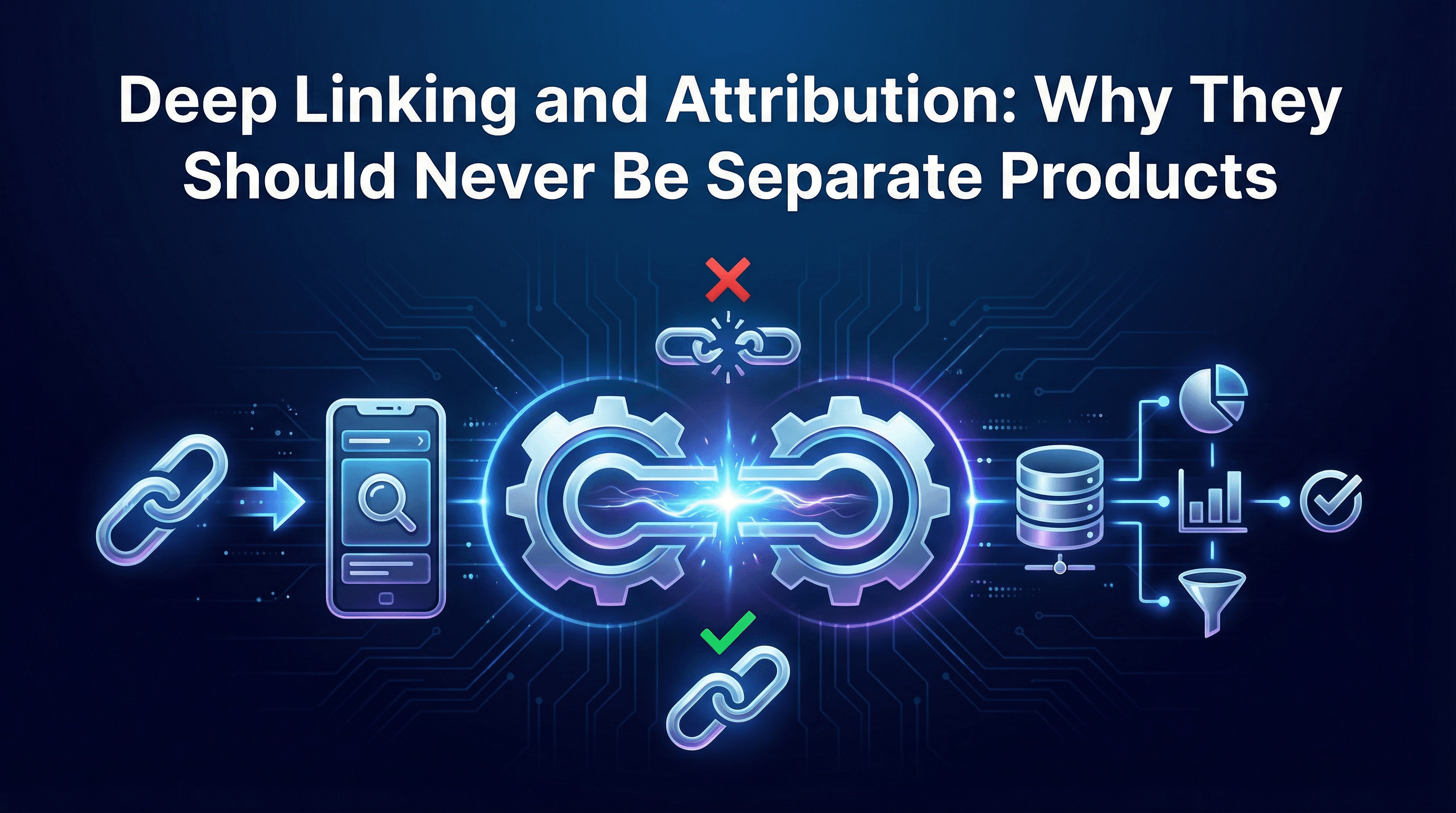
Across attribution audits we've run for growth-stage apps, one pattern keeps appearing: teams running two separate vendors for deep linking and attribution consistently report higher misattribution rates, more engineering tickets, and worse campaign-level visibility than teams using a unified system.
The reason is structural, not accidental. When deep linking and attribution live in different products, data must travel between two systems that were never designed to share context cleanly. Parameters get dropped. Postbacks fire twice or not at all. QA becomes a cross-vendor debugging exercise. And the team paying for both tools ends up spending more on maintenance than they would on a single, integrated solution.
This isn't a sales pitch for consolidation. It's a pattern observed repeatedly across apps spending ₹5L to ₹80L per month on user acquisition, where the fragmentation tax is large enough to measure.
The Industry Default: Why Deep Linking and Attribution Are Sold Separately
The separation exists for historical reasons, not technical ones. Early mobile marketing tools specialised in one problem: Branch started as a deep linking product, while AppsFlyer and Adjust started as attribution platforms. As mobile marketing matured, each expanded into the other's territory, but the architecture remained bolted-on rather than native.
This means most teams today use one vendor for link creation and routing (deep linking) and another for install attribution and postback delivery. The two systems exchange data via webhooks, SDKs, or server-to-server callbacks. When everything works, the separation feels invisible. When something breaks, the separation becomes the single largest source of measurement error.
The deeper issue is incentive alignment. Two vendors have no shared motivation to ensure their systems communicate perfectly. Each optimises for its own dashboard accuracy, not yours. When numbers disagree, both vendors point at the other's integration.
Where Fragmentation Breaks: 3 Specific Failure Patterns
These aren't theoretical. They show up in real attribution audits with measurable budget impact.
Failure Pattern 1: Deferred Deep Link Data Missing from Attribution
A user clicks an influencer's link, lands on the App Store, installs, and opens the app. The deep linking tool correctly routes the user to the promoted product page. But the attribution tool never receives the campaign parameters because the handoff between systems dropped the referrer data.
Result: the install gets attributed to organic. The influencer campaign shows zero installs in the attribution dashboard while the deep linking dashboard shows successful link clicks. The marketer sees conflicting numbers and either overpays the influencer (trusting the deep link clicks) or underpays them (trusting the attribution report).
This pattern typically affects 8-15% of deferred deep link installs when two separate systems handle routing and attribution independently.
Failure Pattern 2: Duplicate Postbacks to Ad Networks
Both the deep linking tool and the attribution tool send install postbacks to Meta or Google. The ad network receives two install signals for the same user and double-counts conversions. Meta's algorithm then "learns" that the campaign is performing twice as well as it actually is, leading to aggressive budget scaling on underperforming creatives.
One eCommerce app we audited was running ₹40L per month on Meta with duplicate postbacks active for three weeks. The effective CPI looked 40% lower than reality. When the duplicates were fixed, the algorithm recalibrated and actual ROAS dropped by 35%, requiring a full campaign restructure.
Failure Pattern 3: Link Routing Works but Attribution Breaks on iOS
After ATT, iOS attribution relies heavily on SKAN postbacks and first-party signals. If your deep linking tool handles the Universal Links routing but your attribution tool manages SKAN conversion value mapping, a single configuration mismatch means users get routed correctly but attribution data never reaches the MMP.
The symptom: perfect deep link performance reports, but the attribution dashboard shows a spike in "unattributed" installs on iOS. Teams often spend weeks debugging this because the issue sits at the integration boundary between two vendors, and neither vendor's support team has full visibility into the other's configuration.
The Data Gap: What Gets Lost Between Two Systems
When deep linking and attribution are separate, several data points routinely fall through the gap.
Campaign parameters on deferred installs. The deep linking tool stores the click parameters. The attribution tool needs those parameters to credit the install. The handoff depends on both systems matching the same device within the same attribution window. When matching fails, the install loses its source, a problem that's invisible unless you actively reconcile link clicks against attributed installs.
Revenue attribution to link-level campaigns. Deep linking tools track link clicks and app opens. Attribution tools track installs and in-app events. Connecting revenue back to the specific link (and therefore the specific influencer, QR code, or email campaign) requires both systems to share a common identifier. In practice, this identifier often gets truncated, reformatted, or dropped during the cross-system handoff.
Cross-platform journey continuity. A user clicks a deep link on mobile web, switches to the app, and completes a purchase. The deep linking tool sees the web click. The attribution tool sees the app install. Neither system independently holds the complete journey. Stitching them together requires custom data pipelines that most teams don't have bandwidth to build or maintain, which is precisely why attribution fails without a single source of truth.
The Cost of Maintaining Two Vendors
Beyond data accuracy, the financial and operational overhead of running separate tools adds up faster than most teams estimate.
Licensing Costs
Most deep linking tools charge based on link volume or monthly active users. Attribution tools charge per install or by seat. Combined, teams typically spend ₹1.5-4L per month on two vendors at growth stage, compared to ₹0.8-1.5L for a unified solution. At 200,000 monthly installs, the delta is ₹12-30L annually. That's budget that could fund an additional UA channel or a full-time analyst.
The maths is straightforward: building or buying separate systems almost always costs more than a single integrated platform once you factor in engineering maintenance.
Engineering Overhead
Two SDKs means two integration cycles, two sets of initialisation logic, two update schedules, and two QA processes. When either vendor ships a breaking change, the engineering team must test the impact on both systems and their interaction.
Based on audits across mid-scale apps, teams maintaining two separate systems spend 4-8 hours per month on cross-vendor debugging alone. Over a year, that's 50-100 engineering hours, roughly ₹3-6L in engineering cost, spent on making two tools talk to each other instead of building product features.
QA Complexity
Testing a unified deep link + attribution flow is one verification path. Testing the same flow across two systems requires validating link creation, device routing, App Store handling, deferred parameter delivery, attribution matching, postback firing, and revenue tracking across both vendor dashboards. Each step is a potential failure point that only surfaces under specific device, OS, and network conditions.
Teams without dedicated QA for this cross-vendor flow typically discover issues from marketers noticing dashboard discrepancies, by which point budget has already been misallocated.
What Unified Deep Linking + Attribution Looks Like in Practice
A unified system means every link created is simultaneously a deep link (routing the user to the right destination) and an attribution link (carrying the campaign parameters through install to in-app events). There's no handoff, no cross-system matching, and no integration boundary where data can get lost.
In practice, this changes three workflows:
Link creation becomes attribution setup. When a marketer creates a link for an influencer campaign, the link automatically carries UTM parameters, campaign identifiers, and deferred deep link payloads. There's no separate step to "configure attribution" for that link. This is the approach behind dynamic deep links that carry context through every user state.
Postback configuration happens once. A single system sends one postback per install to each ad network. No duplicate signals, no conflicting conversion counts, no algorithm confusion.
Revenue connects back to the link. Because the same system handles both the link click and the in-app revenue event, there's a direct data path from campaign source to purchase, without needing a custom data pipeline to join two vendor datasets.
Decision Framework: When Separate Tools Make Sense vs When They Don't
Separation isn't always wrong. In some scenarios, running distinct tools is the right call.
Separate tools may make sense when:
You're an enterprise with a dedicated measurement engineering team that can maintain cross-vendor integrations at production quality.
You have a contractual lock-in with one vendor and can't switch both tools simultaneously.
Your deep linking use cases are extremely specialised (for instance, complex in-app routing logic that requires a standalone deep linking SDK) and your attribution needs are basic.
Unified tools make more sense when:Your team has fewer than 5 people managing growth and UA, and engineering bandwidth for vendor maintenance is limited.
You're spending ₹5-80L per month on UA and need accurate campaign-to-revenue attribution without manual reconciliation.
You're running multiple deep linking use cases (influencer, QR, email, paid ads) and need all of them attributed correctly.
You've experienced the failure patterns described above and want to eliminate them structurally rather than patching around them.
For most growth-stage apps processing 20,000 to 400,000 monthly installs, the unified approach reduces cost, engineering overhead, and data gaps simultaneously.
The Migration Path: Moving from Fragmented to Unified
Switching from two vendors to one doesn't require a big-bang migration. The typical approach works in phases.
Phase 1 (Week 1-2): Parallel integration. Integrate the unified platform's SDK alongside your existing tools. Run both systems simultaneously to validate data parity. Compare install counts, attribution accuracy, and deep link routing success rates.
Phase 2 (Week 3-4): Postback migration. Switch ad network postbacks from your old attribution tool to the unified platform. This is the highest-risk step because ad network algorithms retrain based on the new signal source. Monitor CPI and ROAS closely during the first 7 days.
Phase 3 (Week 5-6): Deep link migration. Redirect existing deep links to the unified platform's link infrastructure. For live campaigns, this can be done gradually by creating new links for new campaigns while maintaining old links until their campaigns end.
Phase 4 (Week 7-8): Decommission. Remove the old SDKs, cancel vendor contracts, and consolidate dashboards.
Total engineering effort: typically 8-16 hours spread across the migration period, assuming the new platform supports your SDK framework (React Native, Flutter, iOS, Android).
Frequently Asked Questions
Does unifying deep linking and attribution mean fewer features?
Not necessarily. A well-built unified platform provides the same deep linking capabilities (dynamic links, deferred deep links, Universal Links, App Links) alongside full attribution (cross-channel attribution, SKAN support, postbacks, fraud detection). The difference is architectural: these features share a data layer instead of communicating across vendor boundaries.
What if my current deep linking tool has features the unified platform doesn't?
Audit the specific features you actually use. Most teams use 20-30% of their deep linking tool's capabilities. If you rely on a niche feature (for instance, complex A/B testing on link destinations), verify it exists before migrating. For the majority of standard use cases, unified platforms cover the same ground.
How do I convince my team to consolidate vendors?
Frame it around three things: cost (two vendor fees vs one), reliability (one data path vs two with integration boundaries), and speed (one QA process vs cross-vendor debugging). If you've experienced any of the failure patterns described above, those incidents become the strongest argument.
Will switching affect my historical attribution data?
Historical data stays in your previous vendor's dashboard. Most unified platforms start attribution from the SDK integration date. Plan for a parallel running period so you have overlap data for comparison.
Is there a minimum scale where unification matters?
The data gap issues start becoming measurable around 10,000-15,000 monthly installs. Below that volume, the discrepancies are harder to detect statistically. Above 50,000 monthly installs, the cost and accuracy differences become significant enough to justify the migration effort.
Key Takeaways
The separation of deep linking and attribution into two products is a legacy of how the mobile marketing industry evolved, not a reflection of how data should flow. When links and attribution share the same system, you eliminate the integration boundary where data gets lost, reduce vendor costs by 30-50%, cut engineering maintenance, and get cleaner postbacks to ad networks.
For teams currently running two separate tools and experiencing misattribution, duplicate postbacks, or cross-vendor debugging cycles, consolidation isn't just a cost optimisation. It's a measurement accuracy fix.
Platforms like Linkrunner were built from day one with deep linking and attribution as a single product. Every link is dynamic and deferred by default, every install is attributed through the same data path, and postbacks fire once per event. For growth teams that want to stop managing the gap between two vendors and start trusting their numbers, request a demo to see how the unified approach works in practice.