
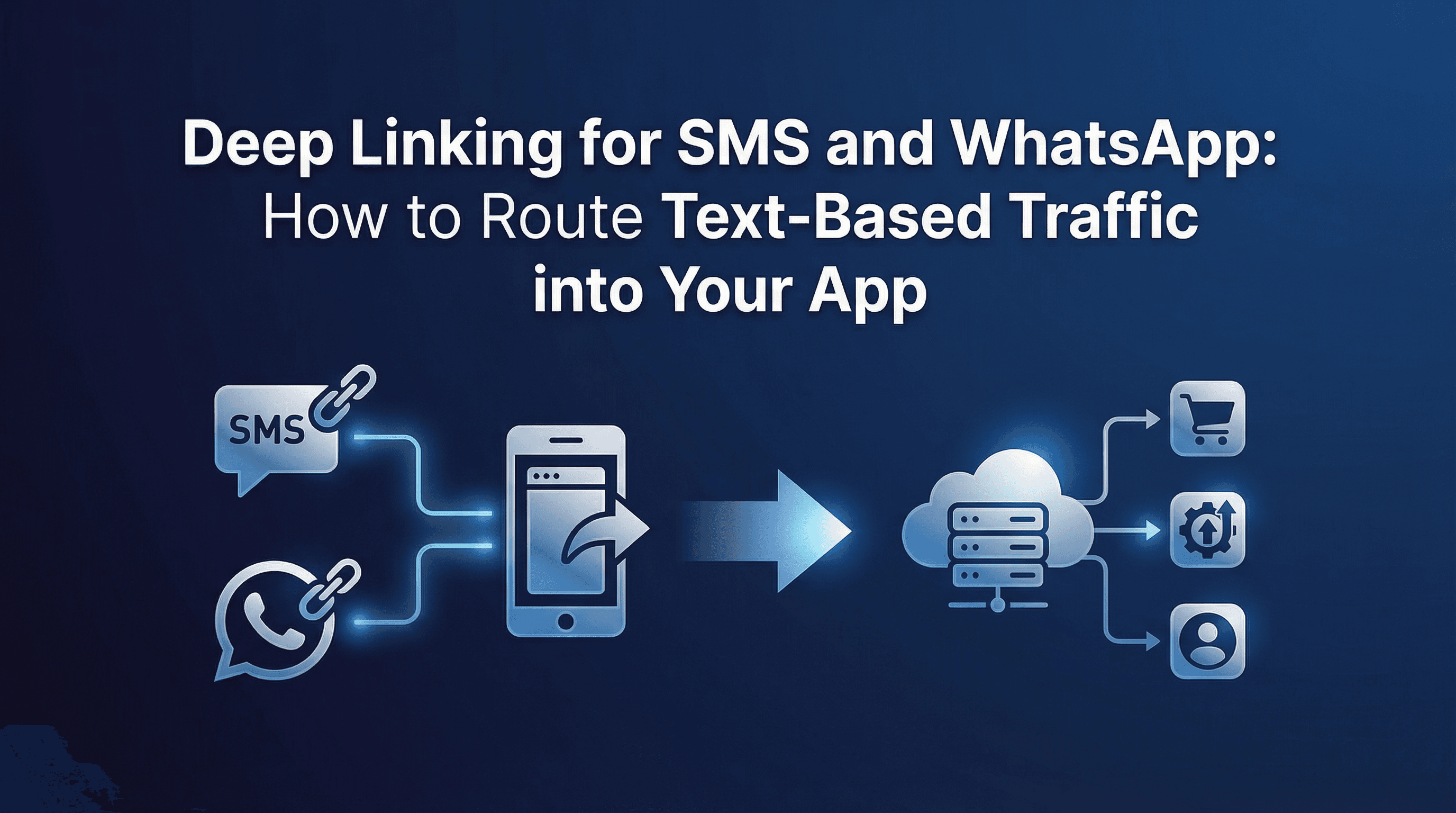
Your push notifications have a 5% open rate. Your emails sit unread. But the SMS you sent at 11 AM? It had a 42% click-through rate within 10 minutes.
Text-based channels like SMS and WhatsApp consistently outperform every other re-engagement channel for mobile apps. Open rates above 90% for SMS and 80%+ for WhatsApp are typical across consumer apps in India. Yet most growth and CRM teams treat these channels as notification pipes, sending messages with generic links that dump users on the app home screen or a mobile web page.
The gap is not reach. It is routing. Without proper deep linking, you are leaving the highest-intent traffic your CRM generates stranded at the front door. This playbook covers how to set up deep links that work reliably across SMS and WhatsApp, handle each channel's constraints, and measure the full text-to-app-action funnel.
The Text-to-App Opportunity
Email re-engagement typically sees 15-25% open rates and 2-4% CTR. SMS and WhatsApp operate in a different league.
SMS delivers near-instant visibility with open rates consistently exceeding 95% for transactional messages and 35-45% for promotional ones. WhatsApp adds richer context through preview cards, inline images, and native CTAs, plus it is often the primary communication channel for Indian users.
The conversion advantage compounds with deep linking. A user who taps an abandoned cart SMS and lands directly on that cart screen converts at 3-5x the rate of one who lands on the home screen. This is the friction reduction that deep linking creates by preserving context from message to in-app destination.
The math is straightforward: SMS and WhatsApp give you the highest open rates, deep linking gives you the highest conversion rates from those opens. Together, they create the most efficient reactivation loop available.
How Deep Links Work in SMS vs WhatsApp
The underlying deep linking mechanics are similar, but each channel handles links differently.
SMS Link Behaviour
SMS is plain text. Links appear as raw URLs with no previews or formatted CTAs. Two constraints matter here.
Character limits affect cost. Standard SMS allows 160 characters per segment, and a long deep link URL can consume 60-80 characters. Short domains and compact URL structures are cost-saving necessities, not cosmetic preferences.
Link rendering varies by device and carrier. Some Android SMS apps require the full https:// prefix to render links as tappable. Others auto-detect URLs but may truncate them visually. iOS Messages renders links more consistently but applies its own preview behaviour for known domains.
The practical impact: your deep links for SMS need short, clean URLs on a branded domain. Avoid query parameters where possible and encode routing data into the link path instead. Dynamic deep links handle this by generating compact URLs that carry routing context server-side rather than in the URL string. A link like links.yourapp.com/s/abc123 is far more deliverable (and cheaper per SMS segment) than a URL with 15 query parameters appended.
WhatsApp Link Behaviour
WhatsApp renders links with preview cards (title, description, thumbnail), acting as a mini landing page within the conversation. However, WhatsApp fetches OG metadata when the message is composed, not when opened, so your link server must return appropriate OG tags on the initial fetch while routing correctly on tap.
WhatsApp also handles redirects cautiously. Multiple redirect hops (common in legacy attribution setups) can trigger "suspicious link" warnings or break preview cards entirely. Single-hop redirects with direct Universal Link or App Link resolution perform best.
One nuance often missed: WhatsApp Desktop does not trigger app-level deep links the same way mobile does. If users access WhatsApp from desktop, your fallback logic needs to route them to a smart landing page that detects the device and redirects accordingly.
Carrier-Level Link Filtering and Deliverability
This is where most SMS deep linking strategies break silently.
Telecom carriers run link filtering systems that flag messages containing URLs matching suspicious patterns: shared short domains, newly registered domains, URLs with excessive query parameters, and domains on spam lists. If your deep links use a shared domain, one bad actor on that domain can tank your delivery rates overnight.
How to protect deliverability:
Use a branded, dedicated domain for deep links (e.g., links.yourapp.com) to isolate your reputation.
Warm new link domains gradually, starting with transactional messages before promotional ones.
Avoid URL shorteners with shared domains.
Register your sender ID and link domain with carrier DLT portals in India (mandatory for commercial SMS).
Monitor delivery rates by carrier weekly. Sudden drops on Jio or Airtel may signal domain flagging.
WhatsApp is less affected by carrier filtering since messages travel over data, not SMS rails. However, WhatsApp's own anti-spam systems can throttle accounts that send too many messages with links users report or ignore.
Transactional vs Promotional Deep Link Strategies
Not all text-based deep links serve the same purpose.
Transactional deep links (order updates, payment confirmations, delivery alerts) have built-in intent. Routing should be precise: an order update SMS links directly to that order's tracking screen, not the orders list. A payment confirmation opens the transaction details view. A delivery alert opens live tracking with the map pre-loaded. The principle: eliminate every navigation tap between link and destination.
These links are generated server-side when the event occurs. Your backend creates a dynamic deep link with correct parameters (order ID, transaction reference) and injects it into the SMS or WhatsApp template in real-time. For high-volume transactional flows (a food delivery app sending thousands of order status updates per hour), ensure your link generation endpoint can handle the throughput without adding latency to the message delivery pipeline.
Promotional deep links (flash sales, abandoned carts, re-engagement nudges) face a higher bar because the user did not request the message. A "50% off" SMS that opens the home screen wastes the opportunity. Link to the specific sale page, the abandoned product, or a personalised recommendation screen.
Segmentation changes the deep link strategy too. A re-engagement message to a user dormant for 30 days should link to a curated "welcome back" screen or their last-viewed content, not a generic promotional landing page. The more precisely you match message content to in-app destination, the less the interruption feels like spam.
For CRM teams running dormant user reactivation, the deep link is the conversion lever. Match the message promise to the in-app destination precisely, and reactivation rates can double.
Deferred Deep Links for Users Who Have Not Installed
A scenario often overlooked: you send a WhatsApp message to someone who has your number but has never installed your app. This is common in D2C (phone numbers from web checkout), fintech (pre-download WhatsApp interactions), and edtech (parents receiving information before their child installs).
Without deferred deep linking, these users tap the link, install from the store, and see a generic onboarding screen. The context from the message is lost entirely. The discount code mentioned in the WhatsApp message? Gone. The specific product that caught their interest? Replaced by a generic home feed.
Deferred deep linking preserves context through the install process. The user taps, installs, opens the app, and lands on the exact screen the link promised. The discount code is pre-applied. The product is displayed. The course enrolment page is ready.
For text-based acquisition, deferred deep links shift install-to-first-action conversion from roughly 15% to 45%. Text traffic is high-intent by nature, and losing that intent during a store redirect is measurable waste.
Implementation note: Deferred deep links for WhatsApp and SMS work best when the link domain is configured with both Android App Links and iOS Universal Links verification. This ensures the app opens directly (without a browser redirect) for users who already have it installed, while gracefully falling back to the store for new users with the context preserved for post-install routing.
WhatsApp Business API: Deep Link Routing from Chatbot Flows
WhatsApp Business API enables multi-step conversations where each interaction surfaces a contextually relevant deep link. A user asking about order status receives a link to the tracking screen. A user browsing a WhatsApp catalogue gets a link to the in-app product page with a personalised offer. A user completing a support interaction can receive a deep link to rate their experience directly within the app.
The key architectural decision is where deep links get generated in the chatbot flow. Two approaches exist.
Pre-generated links work for common destinations (product categories, settings screens, FAQ pages). You create deep links in advance and map them to chatbot intents. This is simpler but less personalised.
Dynamically generated links work for personalised destinations (specific orders, user-specific offers, personalised recommendation screens). This approach requires your deep link platform to expose a low-latency API that the chatbot can call in real-time during the conversation flow.
For teams using CRM platforms like CleverTap, MoEngage, or Braze to manage WhatsApp campaigns, deep link generation typically integrates at the campaign template level. You define the link structure with dynamic user-attribute parameters (user ID, last product viewed, offer code), and the CRM injects the personalised deep link into each message at send time.
Measuring Text-to-App Conversion Rates
The measurement funnel for text-based deep links has five stages, each with distinct drop-off risks.
Send to Delivery: Carrier filtering, DND registrations, and invalid numbers reduce the pool. Track delivery rate by carrier.
Delivery to Read: Hard to measure for SMS (no read receipts). WhatsApp Business API provides read receipts for a true open rate.
Read to Click: Your deep link platform must track clicks with referrer data identifying SMS or WhatsApp as the source.
Click to App Open: Users without the app hit the store; users with the app open directly via Universal Links or App Links. Track the split.
App Open to Target Action: Attribution closes the loop. Did the user who tapped the link complete the intended in-app action? Without connecting clicks to downstream events, you cannot measure true ROI.
Sanity check: Pull the number of deep-linked SMS or WhatsApp messages sent last month. Now pull attributed in-app actions from those links. If you cannot connect these numbers, your measurement stack has a gap hiding the true value of text-based campaigns.
The minimum setup requires a deep link platform tracking clicks with source attribution, an attribution layer connecting clicks to in-app events, and a reporting view showing the full send-to-action funnel. Platforms like Linkrunner generate dynamic links that work natively in SMS and WhatsApp with deferred context preservation, and integrate with CRM tools like CleverTap, MoEngage, and Braze for automated text-to-app workflows with complete funnel tracking.
Frequently Asked Questions
Do SMS deep links work differently on iOS vs Android?
Yes. On iOS with Universal Links configured, tapping an SMS link opens the app directly. On Android, App Links provide similar behaviour, but some SMS apps may open a browser first. Cross-device testing is essential.
How do I handle WhatsApp users who have not installed my app?
Use deferred deep linking. After app store redirect and installation, the app reads the deferred context and routes the user to the screen the link promised, preserving conversion intent through the install.
Will SMS links get blocked by carriers in India?
They can. DLT registration is mandatory, and link domains must be whitelisted. Use a branded domain, warm it with transactional traffic, and monitor delivery rates by carrier.
Can I track revenue from SMS and WhatsApp deep links?
Yes, if your deep links carry source attribution and your platform connects clicks to in-app purchase events. The chain: attributed deep link sent, click tracked, app opened, event triggered, revenue attributed back to the campaign. This is what makes text-based channels measurable beyond vanity metrics like "messages delivered."
Should I use the same deep link structure for SMS and WhatsApp?
The routing logic can be the same, but URL presentation should differ. SMS benefits from shorter URLs due to character limits and cost-per-segment economics. WhatsApp benefits from URLs that return rich OG metadata for preview cards. Use the same deep link platform but configure channel-specific URL formats so SMS gets a compact path and WhatsApp gets full preview rendering.
Text-based channels deliver the highest engagement rates available to mobile app teams. Without proper deep linking, that engagement dissipates at the point of tap. Precise routing, deferred context, and full-funnel measurement turn SMS and WhatsApp from notification pipes into conversion engines.
Start with the checklist above. If you cannot answer "how many purchases came from last week's WhatsApp campaign," close that gap first. For teams looking to operationalise text-to-app deep linking without custom infrastructure, request a demo from Linkrunner to see dynamic links, deferred deep linking, and CRM integrations working together.