
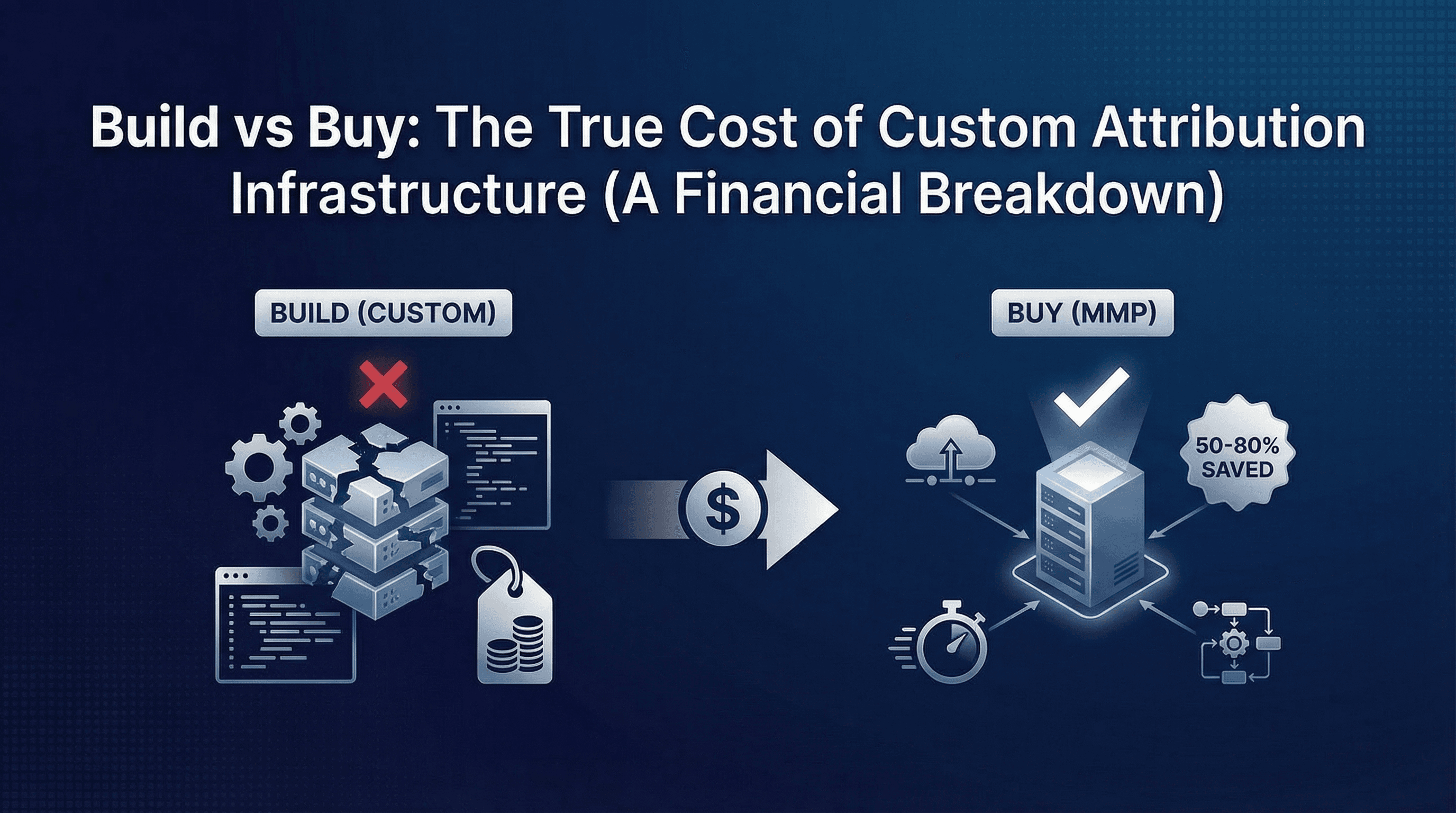
Your VP of Engineering just said it in the Monday planning meeting: "Attribution tracking? We can build that. It's just event logging and API calls."
On paper, they're right. Attribution is conceptually simple. Track clicks, match them to installs, send postbacks to ad networks, display some charts. Your team has built more complex systems before. Why pay ₹40,000-80,000 monthly to an MMP when you could own the infrastructure?
Here's what happens next. Three months in, your two senior engineers are still debugging SKAN conversion value mapping. Your data warehouse costs have doubled. Your fraud detection is catching 40% of the bot traffic that's inflating your numbers. And when Meta changes their postback requirements, you scramble to update integrations across 12 ad networks while your actual product roadmap sits frozen.
The "we can build this" trap catches well-funded startups every quarter. The initial estimate looks reasonable, but attribution infrastructure has a cost structure that reveals itself slowly, like subscription renewals you forgot about. This post breaks down the true total cost of ownership for custom attribution, including the hidden expenses that engineering teams consistently underestimate, so you can make this decision with complete financial visibility.
The Attribution Complexity Iceberg: What Engineering Teams Miss in Scoping Sessions
When engineers scope custom attribution builds, they typically estimate based on what's visible: event ingestion, basic click-to-install matching, a dashboard. That's the 20% above water.
The 80% below includes SKAN 4.0 decoding logic that Apple updates quarterly, fraud detection rules that evolve with bot networks, privacy compliance across GDPR and local regulations, postback management for 15+ ad networks each with different authentication and retry requirements, data retention policies, backup systems, and the ongoing engineering time to maintain all of it.
Most teams discover this 18 months in, when the "simple attribution project" has consumed 4,000 engineering hours and still doesn't match the accuracy of a commercial MMP. By then, the sunk cost fallacy keeps them building instead of switching to a platform designed for this single purpose.
Year 1 Build Costs: The Initial Investment Breakdown
Let's map realistic Year 1 costs for a mid-sized team building attribution from scratch, assuming 100,000 monthly attributed installs and a competent engineering team in India.
Engineering Time (₹18-35 lakh)
Two senior engineers at ₹15-20 lakh annual salary each spend 60% of their time on attribution for 6 months, then 20% ongoing. That's ₹9-12 lakh in direct salary cost, plus another ₹9-12 lakh in opportunity cost for features they didn't build. One backend engineer at ₹12 lakh spends 40% time for 3 months on API integrations (₹1.2 lakh). One frontend engineer at ₹10 lakh spends 30% time for 2 months building dashboards (₹0.5 lakh).
Add another ₹3-5 lakh for product manager time coordinating requirements, QA time validating accuracy, and DevOps time managing infrastructure. Most teams underestimate coordination overhead by 40-60%.
Infrastructure Costs (₹3-6 lakh)
Event ingestion at scale requires robust infrastructure. For 100,000 monthly installs generating 2-3 million events, you need load balancers, application servers, and worker queues. Cloud costs (AWS/GCP) run ₹1-2 lakh monthly for compute and networking.
Data storage for 90-day retention windows with queryable analytics requires a data warehouse. BigQuery or Redshift costs ₹0.8-1.5 lakh monthly at this scale. Add another ₹0.3-0.5 lakh for Redis caching, CDN for link redirects, and monitoring tools.
These are baseline numbers. Traffic spikes, longer retention windows, or real-time analytics requirements can double infrastructure costs.
Third-Party Services (₹2-4 lakh)
Fraud detection isn't optional. You'll need IP databases (₹15,000-25,000 annually), device fingerprinting services (₹40,000-80,000 annually), and possibly a commercial fraud detection API for high-risk traffic. SKAN decoding libraries and postback validation tools add another ₹20,000-40,000.
SMS and email services for postback delivery notifications, error tracking tools like Sentry, and analytics platforms for monitoring your attribution system's performance add up to ₹60,000-1 lakh annually.
Total Year 1 Investment: ₹25-45 lakh
This assumes everything goes smoothly. No major architecture rewrites, no extended debugging of edge cases, no compliance issues requiring legal consultation. In practice, 70% of custom builds exceed initial budgets by 30-50%.
Ongoing Costs: The Maintenance Tax Nobody Budgets For
Year 2 is where custom attribution reveals its true cost structure. The system is live, but it's never "done."
Continuous Engineering Time (₹12-18 lakh)
One senior engineer spends 30% time on maintenance, updates, and bug fixes (₹4.5-6 lakh annually). Ad networks change APIs and postback requirements quarterly. Apple updates SKAN specifications twice yearly, requiring conversion value remapping. Android deprecates tracking methods, requiring SDK updates and testing.
Every time Meta, Google, or TikTok changes their authentication flow, your integrations break. Each change takes 2-4 days to diagnose, update, test, and deploy. Multiply that across 12 ad networks and you're spending 80-120 engineering days annually just staying current.
Another ₹3-5 lakh goes to feature requests from marketing teams: new dashboard views, custom cohort definitions, A/B test attribution support, or integration with new analytics platforms. Marketing's needs evolve faster than planned roadmaps.
Add ₹2-3 lakh for incident response when attribution data suddenly looks wrong, which happens monthly in custom systems due to API rate limits, data pipeline delays, or configuration drift.
Infrastructure & Storage Growth (₹4-7 lakh)
As install volume grows, so do infrastructure costs. Data storage compounds: 90 days of retention for 150,000 monthly installs means 13.5 million events, which costs ₹1.2-2 lakh monthly in warehouse storage and queries. Compute costs scale with complexity as marketing teams request deeper cuts and faster dashboards.
Backup and disaster recovery, which teams often defer in Year 1, become non-negotiable after the first data loss incident. Add ₹0.5-1 lakh annually for backup storage and periodic recovery testing.
Fraud Detection Updates (₹3-5 lakh)
Fraud patterns evolve. The bot networks inflating your click numbers in January use completely different signatures by June. Your fraud rules from launch catch 60% of bad traffic after 12 months, down from 85% initially.
Keeping fraud detection current requires continuous rule updates, new data sources, and often machine learning models that need retraining. Budget ₹1.5-2.5 lakh for fraud service subscriptions, another ₹1-2 lakh for engineering time updating detection logic quarterly, and ₹0.5-1 lakh for investigating fraud patterns that slip through.
Privacy & Compliance (₹2-4 lakh)
Privacy regulations change faster than attribution systems. GDPR compliance requires data subject access request handling, consent management, and data deletion workflows. New regulations like India's DPDP Act add requirements mid-year.
Legal consultation, compliance audits, and engineering time implementing privacy controls cost ₹2-4 lakh annually. This is non-negotiable and scales with regulatory complexity, not install volume.
Total Annual Ongoing Cost: ₹20-35 lakh
This excludes major rewrites, which 60% of custom attribution systems require by Year 3 when initial architecture assumptions no longer hold. That's another ₹8-15 lakh every 2-3 years for structural improvements.
The Hidden Costs Engineering Estimates Never Include
Beyond direct engineering and infrastructure expenses, custom attribution creates secondary costs that only become visible when you're deep into operation.
Opportunity Cost: The Features You Don't Build
Two senior engineers spending 30% of their time maintaining attribution means 30% less time building revenue-generating features. If those engineers could instead build a premium subscription tier, improve onboarding conversion, or reduce churn through better product analytics, the opportunity cost dwarfs the direct costs.
At a typical 15% feature delivery rate reduction, a 10-person engineering team loses 1.5 full-time equivalent engineers to attribution maintenance. That's ₹18-25 lakh in foregone product development annually, compounding as competitors ship features faster.
Dashboard Development: The Infinite Backlog
Marketers want creative-level ROAS breakdowns. Finance wants cohort-based payback analysis. The CEO wants a single ROAS number that matches their mental model. Each request seems simple, but dashboards become 40% of total engineering time in mature custom systems.
Commercial MMPs solve this with pre-built views, configurable filters, and user-driven report builders. Custom systems require engineering time for every new chart. Budget ₹3-5 lakh annually just for dashboard iteration as business needs evolve.
Data Quality Incidents: The Trust Erosion
When your attribution data suddenly shows a 40% ROAS increase overnight, marketing knows it's wrong but can't execute until engineering investigates. Each incident costs 2-5 days of multiple teams' time: engineering debugging, marketing waiting, leadership questioning reliability.
These incidents happen monthly in custom systems due to API changes, data pipeline failures, or configuration errors. The cost isn't just engineering time, it's lost marketing agility and eroded trust in measurement. Teams with unreliable attribution make worse budget decisions because they can't trust their data.
SKAN Implementation: The Compliance Nightmare
Apple's SKAdNetwork requires conversion value mapping, coarse and fine value interpretation, crowd anonymity handling, and postback aggregation logic that changes with each iOS release. Implementing SKAN properly takes 3-4 weeks initially, then 1-2 weeks per quarter for updates.
Most custom systems get SKAN partially right, leaving 20-30% of iOS attribution either missing or misattributed. The cost isn't just engineering time, it's budget misallocation on iOS campaigns that appear more or less effective than reality.
Postback Management: The Integration Multiplier
Each ad network requires different postback formats, authentication methods, and retry logic. Meta wants server-to-server postbacks with specific event parameters. Google requires conversion uploads via API. TikTok has its own event schema.
Supporting 12 ad networks means 12 different integrations, each requiring 3-5 days initial build and 2-3 days per quarter for updates when networks change requirements. That's 180-240 engineering days just for postback management across Year 1 and 2, which is ₹6-10 lakh at standard engineering rates.
When Building Makes Strategic Sense: The Three Exceptions
Custom attribution infrastructure is the right choice for approximately 5% of mobile apps. Here's when building beats buying.
Exception 1: Massive Scale with Unique Requirements
If you're processing 500,000+ attributed installs monthly with highly specific attribution logic that commercial platforms don't support, the economics flip. At this scale, MMP costs reach ₹4-7 lakh monthly (₹48-84 lakh annually), while custom infrastructure maintenance stabilises around ₹30-40 lakh annually.
Massive scale also means larger engineering teams where dedicated attribution engineers don't reduce product velocity. If you have 50+ engineers and can dedicate 2-3 people to attribution full-time, the opportunity cost becomes manageable.
Examples include Flipkart, Swiggy, or Dream11, where attribution requirements are so specific and scale so large that owning infrastructure makes sense.
Exception 2: Custom ML Models for Predictive Attribution
If your product requires sophisticated machine learning models for predictive attribution, multi-touch attribution with custom decay functions, or proprietary fraud detection algorithms that use internal product data, commercial platforms can't deliver what you need.
Building makes sense when attribution is a competitive advantage, not just operational infrastructure. If attribution accuracy directly improves ROAS by 15-20% through better budget allocation, the investment justifies itself.
This applies to fintech apps with complex fraud patterns, gaming apps with nuanced LTV prediction requirements, or marketplace apps with multi-sided attribution needs where commercial platforms fall short.
Exception 3: Extreme Privacy or Compliance Requirements
Some industries require attribution data to never leave specific infrastructure or geographic boundaries. Healthcare apps under HIPAA, financial apps under PCI DSS, or government-adjacent apps with data sovereignty requirements might have compliance needs that commercial platforms can't meet.
If your legal team confirms that no commercial MMP can satisfy your compliance requirements, building becomes necessary, not optional. Budget accordingly and expect 30-40% higher costs than standard custom builds due to security and compliance overhead.
When Buying Wins: The Economic Threshold for Most Teams
For 95% of mobile apps, commercial MMPs deliver better attribution at lower total cost. Here's the economic analysis.
Under 100,000 Monthly Installs: Buying is 5-8× Cheaper
At 60,000 monthly installs, Linkrunner costs ₹48,000 monthly (₹5.76 lakh annually) at ₹0.80 per install. AppsFlyer or Branch costs ₹1.5-2.5 lakh monthly (₹18-30 lakh annually) at their seat-based pricing.
Custom attribution costs ₹25-45 lakh in Year 1, then ₹20-35 lakh annually. Even at Linkrunner's affordable pricing, you're paying 8-12× less than building. At legacy MMP pricing, you're still paying 2-3× less than building.
The decision isn't close. Every hour your engineers spend on attribution is an hour not spent improving product, acquisition, or monetisation features that actually differentiate your app.
100,000 to 300,000 Monthly Installs: Buying Remains Cost-Effective
At 150,000 monthly installs, Linkrunner costs ₹1.2 lakh monthly (₹14.4 lakh annually). Custom attribution still costs ₹20-35 lakh annually in ongoing maintenance, not counting Year 1 build costs.
The engineering time alone justifies buying. Two senior engineers at 30% time costs ₹9-12 lakh annually. Add infrastructure, fraud detection, and incident response and you're spending 2-3× more to build something that commercial platforms do better because attribution is their core product, not a side project.
Time to Value: 1.5 Hours vs 6 Months
Linkrunner SDK integration takes 1.5 hours. Create links, start seeing attributed data within 24 hours, and have full campaign optimisation running within a week. Custom builds take 6-9 months to reach basic functionality, then another 6 months of iteration before marketing teams trust the data enough to make budget decisions.
The 12-18 month delay means running UA without reliable attribution for over a year. How much budget gets misallocated during that time? For most teams spending ₹10-30 lakh monthly on acquisition, even a 10% misallocation due to poor attribution costs ₹12-36 lakh annually, more than the MMP would cost.
The Decision Framework: Four Questions to Ask Before Building
If you're still considering custom attribution, ask these four questions. If you can't answer all four with confidence, buy instead.
Question 1: Do We Have 2-3 Engineers We Can Dedicate Full-Time?
Attribution isn't a part-time project. If your answer is "we'll split time between attribution and other priorities," you're setting up for a failed build that drags on for 18 months while delivering subpar results.
You need dedicated ownership or the project will perpetually deprioritise against features that directly impact user-facing metrics.
Question 2: Can We Afford 12-18 Months Without Reliable Attribution?
Custom builds take 6-9 months to basic functionality, then another 6-9 months before marketing teams trust the data. Can your acquisition strategy survive 12-18 months running partially blind?
If you're spending ₹20+ lakh monthly on UA, every week of poor attribution costs money through misallocated budgets. The opportunity cost of delayed measurement often exceeds the cost of the MMP.
Question 3: Do We Have Requirements No Commercial Platform Can Meet?
Be specific. "We want to own our data" isn't a requirement, it's a preference. Commercial MMPs like Linkrunner offer unrestricted data exports and API access.
Real unique requirements sound like: "We need to run attribution on-premise behind our firewall for compliance reasons" or "We need custom multi-touch attribution with proprietary decay functions that use internal product signals." If your requirements are standard (cross-channel attribution, fraud detection, SKAN support), platforms already solve these better than you will.
Question 4: Do We Have Budget for Ongoing Maintenance?
Building is Year 1. Maintenance is Years 2-10. Can you commit ₹20-35 lakh annually for ongoing engineering time, infrastructure scaling, fraud detection updates, and compliance requirements?
If that budget could instead fund growth experiments, product improvements, or additional marketing spend, you're better off buying a platform that costs 50-80% less and requires zero maintenance.
How Linkrunner Changes the Economics
Traditional MMPs like AppsFlyer and Branch charge ₹2.5-8 per install with seat limits and feature paywalls, pushing many teams toward custom builds. At those prices, the build vs buy calculation gets closer.
Linkrunner shifts the economics by offering industry-low pricing at ₹0.80 per install with no seat limits and full feature access from day one. For a team driving 100,000 monthly installs, that's ₹80,000 monthly (₹9.6 lakh annually) vs ₹25-45 lakh to build in Year 1 and ₹20-35 lakh in ongoing annual costs.
The value isn't just cost reduction. It's what your engineering team builds instead. Those two senior engineers who would spend 6 months building attribution can instead improve onboarding conversion by 15%, which increases customer lifetime value by multiples more than owning attribution infrastructure.
Linkrunner includes capabilities most custom builds never implement: campaign intelligence dashboards showing creative-level ROAS, automated postback optimisation that sends quality-user conversion data directly to Meta and Google, fraud protection that updates weekly as bot patterns evolve, and SKAN 4.0 wizard setup that takes 15 minutes instead of 3 weeks.
You get attribution infrastructure built by a team that does nothing else, updated continuously, with support when ad networks change requirements, at a price that's 3-5× lower than building yourself.
Key Takeaways
Custom attribution infrastructure looks simple to build but reveals its complexity slowly over 18-24 months. The true cost includes direct engineering time, infrastructure, fraud detection, ongoing maintenance, opportunity cost of features not built, and secondary costs like dashboard development and compliance updates.
For most teams processing under 300,000 monthly installs, buying a commercial MMP delivers better attribution at 50-80% lower total cost than building. The economic threshold where building makes sense is around 500,000 monthly installs, and even then only if you have unique requirements that platforms can't meet.
The "we can build this" mindset underestimates the 80% of attribution complexity that isn't visible in initial scoping: SKAN decoding, fraud detection updates, privacy compliance, postback management across 12 ad networks, and continuous maintenance as ad platforms change requirements.
If you're considering building, run the full TCO calculation including Year 1 build costs, ongoing annual maintenance, infrastructure scaling, fraud detection, and opportunity cost of engineering time. Compare that against platforms like Linkrunner that offer transparent pricing at ₹0.80 per install with zero maintenance burden.
Most teams discover 18 months into a custom build that they've spent ₹45-60 lakh building something that works at 80% accuracy, requires constant maintenance, and still can't match the feature set of a commercial platform that costs ₹10-15 lakh annually. By then, switching means admitting sunk costs and starting over.
Make the build vs buy decision with complete cost visibility, not engineering optimism. Attribution infrastructure is a solved problem. Unless you're at massive scale with genuinely unique requirements, buying beats building on economics, time to value, and engineering opportunity cost.
Ready to see how Linkrunner's attribution platform eliminates the build burden while delivering campaign intelligence, fraud protection, and automated postback optimisation at ₹0.80 per install? Request a demo from Linkrunner and get attribution running in 2 hours instead of 6 months.
Frequently Asked Questions
How long does it take to build custom attribution infrastructure?
Most teams take 6-9 months to reach basic functionality (click tracking, install matching, simple dashboards), then another 6-9 months before marketing teams trust the data enough to make budget decisions. Factor in SKAN implementation, fraud detection, and postback automation and you're looking at 12-18 months to feature parity with commercial MMPs.
What's the biggest cost teams miss when estimating custom builds?
Ongoing maintenance. Teams budget for Year 1 build costs but underestimate that attribution requires 20-30% of engineering time indefinitely. Ad networks change APIs quarterly, privacy regulations evolve, fraud patterns shift, and marketing teams request new dashboard views constantly. Budget ₹20-35 lakh annually for maintenance after the initial build.
At what scale does building attribution make economic sense?
Around 500,000 monthly attributed installs, assuming you have unique requirements that commercial platforms can't address. Below that threshold, platforms like Linkrunner cost 50-80% less than custom builds even before counting engineering opportunity cost. Above 500,000 installs, the economics get closer but platforms still win on time to value and maintenance burden.
Can we build basic attribution now and add features later?
This rarely works. Teams that start with "basic" attribution spend 12-18 months in a partial state where marketing can't fully trust the data. Meanwhile, acquisition budgets get misallocated. Starting with a commercial platform gives you complete attribution on day one, then you can evaluate building only if you hit scale or develop genuinely unique requirements.
How do commercial MMPs handle SKAN implementation better than custom builds?
Commercial platforms update SKAN logic continuously as Apple changes specifications. Custom builds require engineering time every iOS release to update conversion value mapping, postback interpretation, and crowd anonymity handling. Most custom systems get SKAN partially right, leaving 20-30% of iOS attribution either missing or misattributed, which causes iOS campaigns to appear more or less effective than reality.
What's included in Linkrunner's ₹0.80 per install pricing?
Full attribution platform including dynamic and deferred deep linking, cross-channel attribution across Meta/Google/TikTok/affiliates/influencers, campaign intelligence dashboards with creative-level ROAS, automated postback optimisation, SKAN 4.0 wizard, fraud protection, and unrestricted data exports. No seat limits, no feature paywalls, no hidden fees. You pay only for attributed installs with 3,000 free installs monthly.