
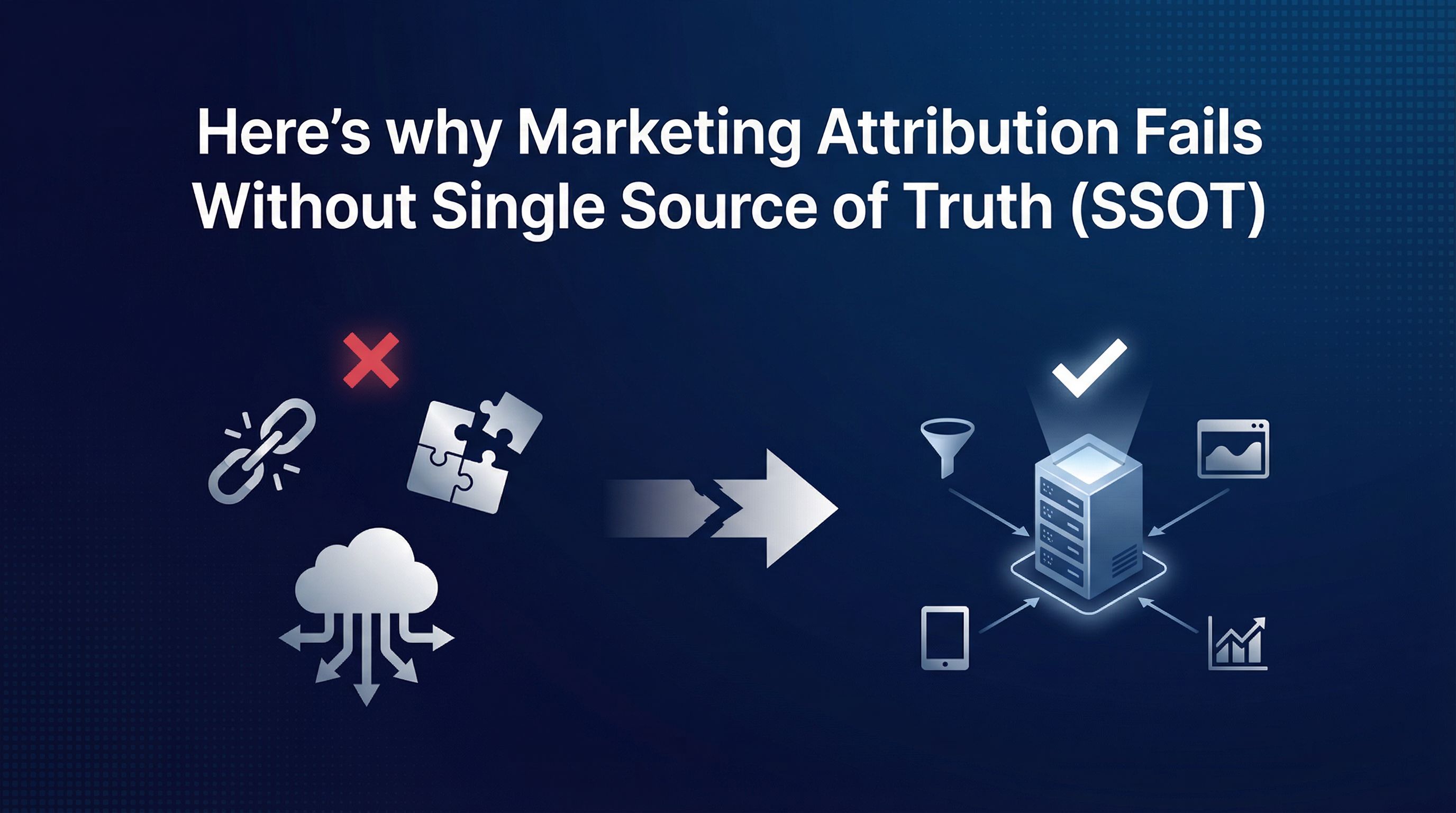
Your growth team says Meta drove 1,200 installs last week. Google Ads Manager claims 1,400. Your analytics dashboard shows 950. When finance asks which number to use for the board deck, no one has an answer—and that's exactly why your attribution is broken.
Without a single source of truth, every channel inflates its own performance, double-counts conversions, and leaves you guessing which campaigns actually drive revenue. This guide explains why fragmented attribution data costs you real money, how SSOT fixes it, and what it takes to build attribution your entire team can trust.
What Is Single Source of Truth for Marketing Attribution
A single source of truth (SSOT) for marketing attribution is one unified platform where all your click, install, event, and revenue data lives. It's where every team goes to answer "which campaign drove this install?" or "what's our actual ROAS on Meta?"
Think of it as the authoritative record that eliminates conflicting numbers across ad platforms, analytics tools, and spreadsheets. Your growth, finance, and product teams all reference the same data when making decisions—no more debates about whose dashboard is "right."
Source of Truth Meaning in Marketing Analytics
In marketing analytics, "source of truth" means the single place your team trusts to answer attribution questions. When you ask "did this user come from our Meta campaign or our Google ad?" your source of truth gives you one answer.
Without it, you get three different answers depending on which tool you're looking at. You're left reconciling screenshots and wasting time that could go toward optimizing campaigns.
Single Source of Truth Data vs Scattered Dashboards
SSOT data is unified, deduplicated, and timestamped consistently across every marketing channel. Scattered dashboards show conflicting numbers because each platform tracks differently—Meta uses last-click attribution with a 7-day window, Google might use a 30-day view-through model, and your app analytics tool counts only users who opened the app.
Here's what happens in practice:
SSOT data: One install count, one revenue figure, one ROAS per campaign
Scattered dashboards: Meta says 1,000 installs, Google says 1,200, your analytics tool says 900
No one knows which to believe.
System of Record vs Source of Truth for Attribution
A system of record stores raw data—like your database or data warehouse. A source of truth is the cleaned, contextualized view your team uses to make decisions.
For attribution, your mobile measurement partner (MMP) acts as both. It ingests raw event data from ad networks and your app, deduplicates it, applies attribution logic, and surfaces the results in dashboards your team actually uses. If your MMP isn't your source of truth, you're probably still living in spreadsheets.
The Hidden Cost When Attribution Lacks SSOT
When attribution data lives in multiple places, the damage isn't abstract—it's real money and real time lost. You're not just dealing with "messy data." You're dealing with wasted ad spend, missed revenue opportunities, and teams that can't move fast because they're stuck reconciling numbers.
Wasted Ad Spend From Misattributed Channels
Without SSOT, you might scale a channel that looks good in its own dashboard but actually has poor incrementality or double-counted conversions. Meta's Ads Manager might show a 4x ROAS on a campaign, but if the same users also clicked a Google ad right before installing, you're counting the same revenue twice.
Result: you pour budget into a channel that's not as profitable as it appears. Meanwhile, you're underinvesting in channels that actually drive incremental growth.
Lost Revenue From Slow Campaign Optimization
When your team spends three days reconciling data before making a decision, underperforming campaigns keep running. Winning campaigns don't get scaled fast enough.
You spot a TikTok campaign crushing it on day one. By the time you've verified the numbers across platforms and gotten internal alignment, you've missed the window to 3x the budget while momentum was high. Speed matters in performance marketing, and fragmented data kills speed.
Hours Burned Reconciling Platform Data
Growth teams manually export CSVs, compare Meta vs Google vs internal analytics, and build pivot tables to "true up" the numbers. Even if you eventually land on an answer, you've burned hours that could've gone toward creative testing, audience experiments, or launching a new channel.
The operational drag compounds every week.
Why Fragmented Data Breaks Your Attribution
Fragmented data doesn't just slow you down—it makes your attribution fundamentally unreliable. The numbers never match up, and that breaks your ability to make confident decisions.
Different Numbers in Meta vs Google Ads Manager
Each ad platform reports different install counts because they use different attribution windows, different models (last-click vs view-through), and different definitions of what counts as a "conversion." Meta might claim credit for an install if the user saw an ad in the last 7 days. Google uses a 30-day window and counts view-throughs.
Both platforms are incentivized to show you the highest possible numbers—they're not neutral arbiters. Without an independent SSOT, you can't know the truth.
Double-Counted Installs and Conversions
The same user can be claimed by multiple channels. They see an influencer post, click a Meta ad, then click a Google ad, then install your app.
Meta says "that's my install." Google says "that's my install." Your total "attributed installs" now exceeds your actual installs by 30%. This isn't a rounding error—it's a systemic problem that inflates your reported performance and makes every ROAS calculation meaningless.
Blind Spots in Multi-Touch Attribution
When data is fragmented, you lose visibility into the full user journey. Did a user discover your app through an influencer, engage with a Meta retargeting ad, then convert via a Google search ad?
Without SSOT, you only see the last click. You miss the fact that your influencer campaigns are driving top-of-funnel awareness that makes your paid ads work. You end up cutting budgets on channels that are actually critical to your funnel because you can't see how they contribute.
ROAS That Nobody Trusts
When finance, founders, and marketing see different ROAS numbers, no one believes any of them. Decisions stall or get made on gut feel instead of data—which defeats the entire purpose of running performance marketing.
Here's what happens in a Monday morning meeting:
Meta Ads Manager: 3.2x ROAS
Google Analytics: 2.1x ROAS
Your spreadsheet: 2.8x ROAS
Finance's question: "Which one is real?"
No one has an answer, so the budget decision gets punted to next week. Your competitor who has clean attribution data just scaled their winning campaign.
How Single Source of Truth Software Fixes Attribution
An SSOT platform—like a mobile measurement partner—solves attribution problems by ingesting data from every channel, deduplicating it, and applying consistent attribution logic. Here's what that actually means.
Unified View Across All Marketing Channels
SSOT software connects to Meta, Google, TikTok, OEM campaigns, influencer tracking links, and organic sources. Then it deduplicates installs using a consistent attribution model.
When a user clicks multiple ads before installing, the MMP decides which channel gets credit based on rules you define—last-click, first-click, or probabilistic modeling for iOS SKAN. One install equals one source. No double-counting, no conflicting dashboards.
Real-Time Campaign Performance Tracking
With SSOT, you see installs, in-app events, and revenue as they happen—no waiting for CSVs to export or manual updates to spreadsheets. You launch a campaign at 9 AM, and by 11 AM you know whether it's driving quality users or burning budget.
Faster feedback loops mean faster optimizations. You catch winners early and kill losers before they drain your budget.
Accurate ROAS and LTV by Channel
SSOT ties revenue events back to the originating campaign, giving you true ROAS and LTV per channel. When a user installs via a Meta ad and makes a purchase three days later, that revenue gets attributed to Meta—even if the user also clicked a Google ad in between.
You stop guessing which channels drive profitable users and start knowing. That means you can confidently shift budget toward what's working.
Attribution Models Everyone Can Explain
SSOT platforms use clear, auditable attribution logic—last-click with a 7-day window, or probabilistic modeling for SKAN. Finance and founders can understand and trust the numbers because it's not a black box.
Linkrunner's user-level identity stitching and SKAN 4.0 decoding make attribution explainable. You can show exactly why a specific install was attributed to a specific campaign, which builds trust across your organization.
Building Your Attribution SSOT
Here's how to move from attribution chaos to a system everyone trusts. This is the process teams follow when they're tired of reconciling spreadsheets and ready to make data-driven decisions fast.
Step 1: Map Your Current Attribution Chaos
Start by auditing where attribution data lives today. List every ad platform, analytics tool, spreadsheet, and Slack thread where numbers get discussed.
Write down the conflicts: Meta says X installs, Google says Y, your internal analytics says Z. Identify the gaps—which channels aren't tracked at all? Which user journeys are invisible?
This step is uncomfortable. Most teams realize their data is messier than they thought. But it's the foundation for everything that follows.
Step 2: Select Your Single Source of Truth Database
Choose an MMP as your SSOT, not a patchwork of tools duct-taped together. Look for lightweight SDKs that won't slow down your app, server-to-server APIs for backend event tracking, and support for SKAN, deep linking, and multi-touch attribution.
Linkrunner integrates in minutes instead of weeks—no months-long engineering projects, no complex onboarding. The pricing is 3–5x more affordable than legacy MMPs, built for India and similar emerging markets.
Step 3: Connect Every Marketing Channel
Integrate Meta, Google, TikTok, OEM campaigns, influencer tracking links, and any other paid or organic sources to your MMP. Make sure all clicks and installs flow through one system.
This is where you stop relying on each platform's self-reported numbers and start trusting an independent third party to deduplicate and attribute correctly. If a channel isn't connected, it's invisible.
Step 4: Define Your Point of Truth Rules
Set clear attribution rules and document them. Last-click with a 7-day window? First-click? Probabilistic modeling for SKAN?
Whatever you choose, make sure everyone—marketing, product, finance—agrees on the methodology before you roll it out. The specific model matters less than consistency: once you pick one, stick with it so your data is comparable week over week and month over month.
Step 5: Get Teams Using Single Source of the Truth
Roll out access to the SSOT platform across growth, product, and leadership. Train teams to stop exporting from ad platforms and start pulling reports from the MMP.
Make it the default: when someone asks "how's the Meta campaign performing?" the answer comes from your MMP, not from Meta Ads Manager. This shift takes discipline—old habits die hard. Once everyone's looking at the same numbers, decisions get faster and trust goes up.
Turn Attribution Into Your Growth Engine
When attribution is trustworthy and unified, it stops being a reporting chore and becomes the foundation for faster, smarter growth decisions. You move from "let's reconcile the data" to "let's scale what's working."
With SSOT, you spot underperforming campaigns in hours instead of days and reallocate budget immediately. No more waiting for weekly reports or Monday morning meetings to make the call.
Linkrunner's AI auto-surfaces what to optimize—flagging campaigns with declining ROAS, highlighting channels driving high-LTV users, and showing you exactly where to shift budget for maximum impact. Your team moves from manual reporting to always-on intelligence.
If you're ready to stop reconciling spreadsheets and start trusting your attribution, request a demo and see how Linkrunner unifies your data in one place.
FAQs about Single Source of Truth for Attribution
What's the difference between SSOT and a marketing dashboard?
A dashboard visualizes data, but an SSOT is the authoritative system where that data is stored, deduplicated, and governed—dashboards pull from the SSOT.
How quickly can you implement attribution SSOT?
With modern MMPs like Linkrunner, integration takes minutes via lightweight SDKs and server-to-server APIs, not weeks of engineering work.
Does SSOT handle iOS privacy and SKAN attribution?
Yes—SSOT platforms decode SKAN 4.0 postbacks and stitch them with user-level Android data, giving you a unified view across iOS and Android attribution.
Can spreadsheets be your single source of truth for attribution?
No—spreadsheets can't deduplicate installs, track real-time events, or integrate directly with ad networks, so they'll always show conflicting or outdated data.