
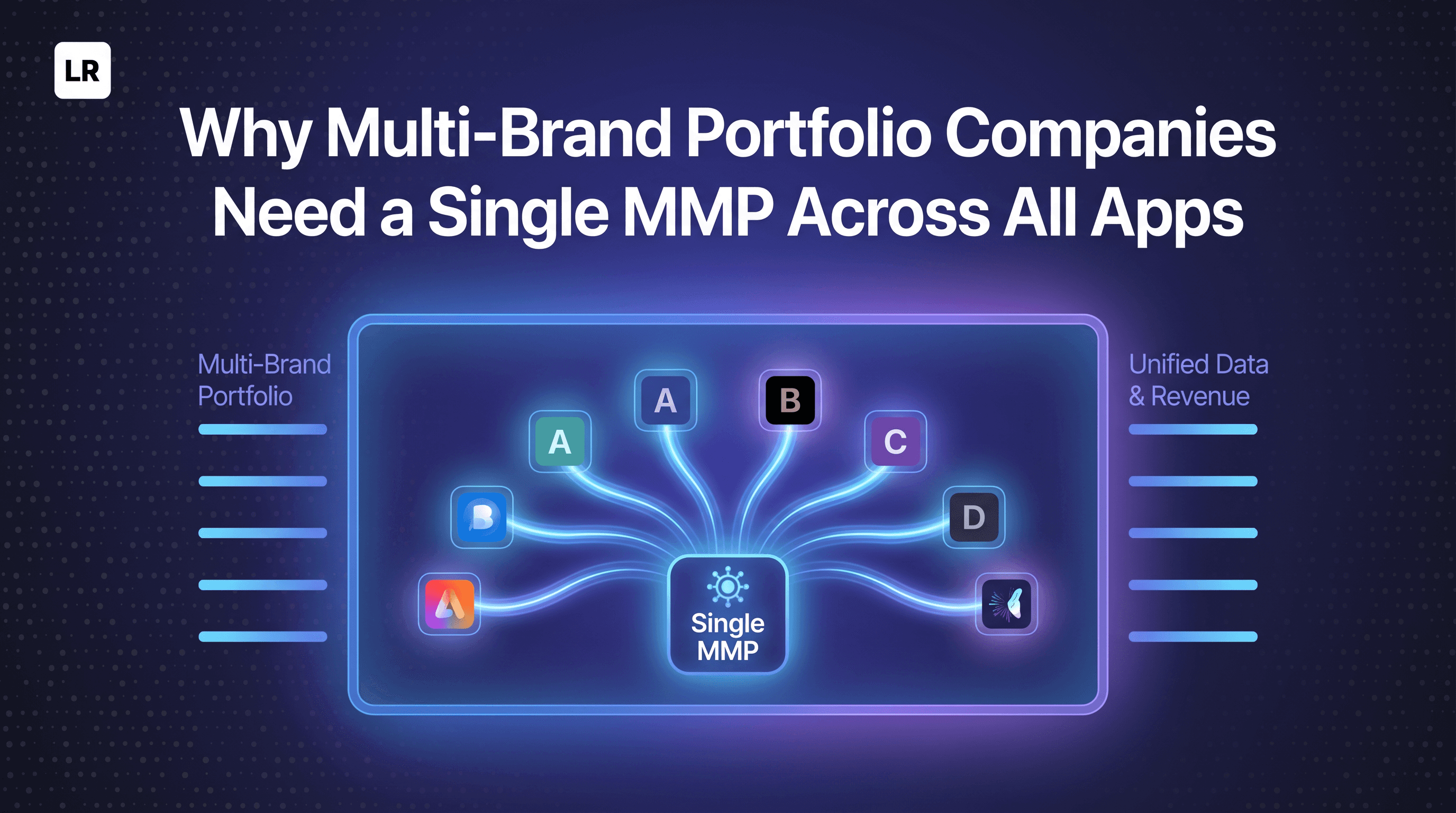
Across portfolio company audits we have reviewed, a consistent pattern emerges: three to five brands, each with its own MMP contract, each running its own event taxonomy, and each reporting a healthy paid-vs-organic split in isolation. When the data gets pulled into the parent company's data warehouse, 15-20% of "new paid users" on one brand turn out to be active users on a sister brand already. The ads worked. The users were real. But the same portfolio was effectively paying to move users between its own apps.
This is the hidden tax of fragmented attribution in a multi-brand context. Each brand's MMP is blind to the others, so cross-brand cannibalisation is invisible until someone builds a cross-brand view. That view is almost always an afterthought, and by the time it exists the quarterly budget is already spent.
The Portfolio Company Measurement Problem
Portfolio companies inherit a measurement structure that suited a single-brand world and is now working against them.
Each brand signed its own MMP contract, often at enterprise pricing that scales per-brand rather than per-group.
Event taxonomies evolved independently, so "signup_completed" on Brand A rarely matches "account_created" on Brand B.
Shared creative teams and shared audience seeds operate on different metric definitions.
Blended ROAS reported to the parent CMO hides the cross-brand overlap entirely.
The "why do all our brands seem to do equally well, and why is total portfolio growth slower than the sum of its parts" question almost always traces back here.
Where Budget Leaks in Multi-Brand Portfolios
Four concrete leakage categories surface repeatedly.
Retargeting overlap: Brand A's prospecting campaign targets lookalikes of its paying users. Those lookalikes are disproportionately already paying customers of Brand B. The install fires, the first payment never does, and the CAC looks fine in isolation.
Duplicate fraud signals: bot installs caught on Brand A rarely get blocked across the rest of the portfolio because fraud lists do not travel between MMPs.
Inconsistent attribution windows: Brand A uses 7-day click, Brand B uses 30-day click, which makes any cross-brand comparison meaningless.
Creative-level ROAS blindness: shared creative assets get tested on one brand at a time, so the portfolio learns slowly when a winner emerges.
How to design mobile app event taxonomy that lasts covers the taxonomy foundations that enable cross-brand reporting. Without a shared taxonomy, consolidated dashboards break on column names alone.
What a Consolidated MMP Unlocks for Portfolios
The value of a single MMP across a portfolio is structural, not cosmetic.
Cross-brand audience management:
Build portfolio-wide exclusion lists of existing sister-brand customers and push them into Meta Custom Audiences and Google Customer Match so prospecting campaigns skip them.
Run co-marketing campaigns with proper credit split between brands.
Segment lookalikes by portfolio-wide payment behaviour, not brand-local behaviour.
Unified fraud defence:Bot networks blocked on one brand block across all.
Device fingerprints flagged as suspicious propagate portfolio-wide.
Click farm detection operates on a larger, more reliable signal base.
Creative and campaign benchmarking:Shared creative library with creative-level ROAS across brands.
Budget allocation decisions based on like-for-like metrics.
Faster learning cycles because winners are spotted across a larger sample.
Procurement simplicity:One contract instead of three to five.
Consolidated volume unlocks better pricing tiers.
One SDK maintenance lifecycle across all engineering teams.
The Governance Layer: What Central Teams Need
Portfolio companies have a legitimate concern: will a single MMP erase the autonomy each brand needs to operate? The answer is no, if the MMP supports proper role-based access.
Brand-level access: each brand's marketing team sees only its own data by default.
Portfolio-level access: central teams, the parent CMO, and finance see aggregated and cross-brand views.
Creative and audience sharing: opt-in libraries where brands can share winning creatives and exclusion audiences.
Cost allocation: consolidated MMP fee split by brand install volume, visible in each brand's P&L.
The MMP contract negotiation checklist covers the clauses that matter most when negotiating a portfolio contract. Data portability, role-based access, and transparent overage pricing are non-negotiable.
Budget Impact: What Portfolios Recover in the First Six Months
Conservative estimates from portfolio-scale attribution audits.
Cross-brand exclusion savings: 10-15% CAC reduction as prospecting audiences stop targeting existing sister-brand customers.
Procurement savings: 20-35% reduction in total MMP spend through one-contract consolidation instead of per-brand enterprise agreements.
Fraud savings: 3-6% of paid spend recovered as bot and fake install protection propagates portfolio-wide.
Operating time savings: 30-50% reduction in quarterly reporting time, as central finance no longer has to reconcile three MMPs' definitions.
Tech Explainer: Why portfolio MMPs benefit from tiered pricing curves
Legacy MMPs priced at Rs3-8 per install do not get cheaper at portfolio scale because enterprise agreements often lock each brand into its own pricing curve. Modern tiered MMPs with volume-based pricing like $0.007-0.012 per install naturally reward consolidated volume. A portfolio running 300,000 monthly installs across three brands pays more on separate contracts than it would on a single contract at the same volume. How much does an MMP actually cost breaks down the pricing curves across the main vendors.
How to Migrate a Portfolio to a Single MMP Without Downtime
Portfolio migrations are more sensitive than single-brand migrations because any data gap compounds across brands. The phased approach that works.
Phase 1: Standardise event taxonomy (weeks 1-3)
Define a portfolio-wide event naming convention.
Map each brand's existing events to the new convention.
Retain brand-specific custom events as sub-tags rather than renaming them entirely.
Phase 2: Parallel tracking on pilot brand (weeks 4-7)Pick the smallest brand as the pilot.
Install the new MMP SDK alongside the existing one.
Validate click, install, and revenue parity for 30 days.
Phase 3: Migrate brands in sequence (weeks 8-16)One brand at a time, with a 30-day parallel tracking window each.
Hold the pilot's learnings to accelerate migrations 3, 4, and 5.
Lock the old MMPs to read-only mode before full cutover.
Phase 4: Consolidate governance (weeks 17-20)Deploy portfolio-level dashboards.
Set up role-based access for brand and central teams.
Retire the old MMP contracts on their earliest termination dates.
The complete MMP migration playbook covers the single-brand version of this flow in depth, and most of it extends directly to portfolio contexts.
Where Linkrunner Fits for Portfolio Companies
Portfolio companies need three specific capabilities from an MMP: unlimited brand scaling without per-brand gating, role-based access with brand and portfolio layers, and transparent tiered pricing that rewards consolidation rather than punishing it.
Platforms like Linkrunner were built without seat limits, without per-brand paywalls, and with unlimited Meta and Google account consolidation. Tiered pricing at $0.007 to $0.012 per install naturally unlocks volume discounts as portfolio scale grows. Open data exports to BigQuery, Redshift, and Snowflake let central data teams build the cross-brand views they need without begging the MMP for a feature request.
For portfolios currently running three to five separate legacy MMP contracts, consolidation usually recovers 30-50% of MMP spend in the first renewal cycle, before counting the cross-brand cannibalisation savings.
Portfolio MMP FAQs
Should a multi-brand company use one MMP or one per brand?
One MMP, with proper role-based access so each brand team sees only its own data. Fragmenting across MMPs creates cross-brand blindness that costs more than the savings from any brand-specific feature preference.
How do I set up cross-brand audience exclusions in an MMP?
Use the MMP's audience builder to assemble device or user ID lists of existing sister-brand customers, refresh weekly or on every new paying-user event via API, and sync them into Meta Custom Audiences and Google Customer Match as exclusion lists. The actual exclusion happens inside the ad platform; the MMP's job is to maintain the portfolio-wide seed list.
What does MMP consolidation typically save a portfolio company?
Conservative estimates: 20-35% reduction in MMP spend through consolidated procurement, 10-15% CAC reduction from cross-brand exclusions, 3-6% fraud savings, and 30-50% operating time savings on reporting.
How do I migrate multiple brands to a single MMP without breaking historical data?
Phased migration with 30 days of parallel tracking per brand, starting with the smallest. Preserve historical data exports from the outgoing MMPs before cutover. Never cut over more than one brand at a time.
Can one MMP contract cover apps across different business units?
Yes, on modern tiered MMPs. Check the contract for seat limits, per-app pricing, and any data isolation requirements your brands have. Regulated verticals like insurance or fintech may need additional access controls.
One Contract, One Taxonomy, One Dashboard
Fragmented attribution is a tax that scales with portfolio size. Each additional brand adds a contract, a taxonomy, and a blind spot. Consolidating onto a single MMP with proper role-based access usually recovers 20-35% of MMP spend, 10-15% of CAC, and 30-50% of reporting time, while unlocking the cross-brand audience seeding and fraud defence that fragmented setups physically cannot deliver. The full migration runs 16-20 weeks when done properly, which is shorter than most portfolio-wide rebranding projects.
If your portfolio is running three or more MMP contracts today, talk to Linkrunner about walking through a consolidation scenario against your current renewal dates. The simpler move is to at least standardise event taxonomy across brands this quarter, because without that, any future consolidation is a rebuild rather than a migration.