
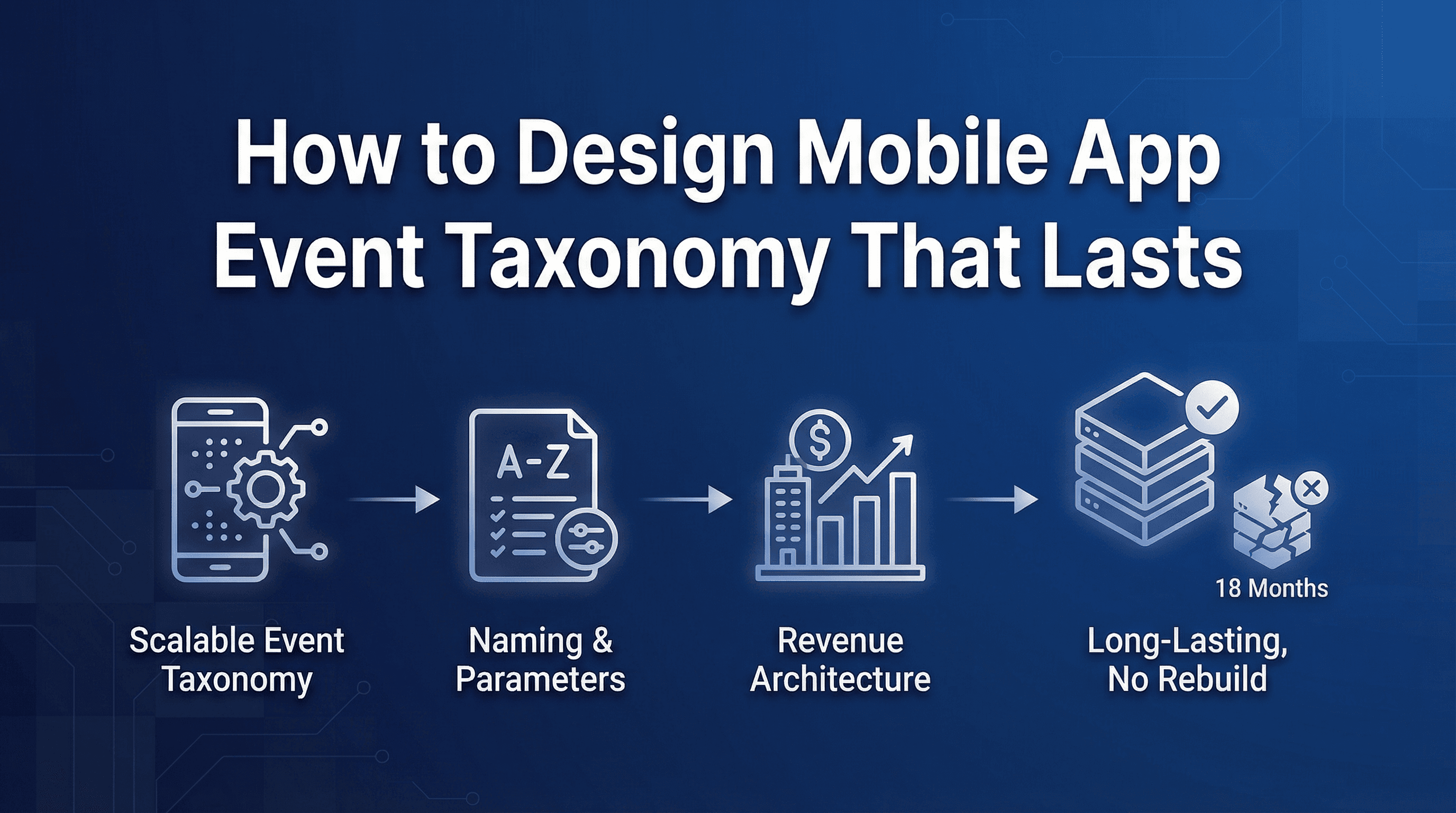
You're three months into tracking 147 custom events across your app. Marketing wants to measure retention by completed actions. Product needs funnel drop-off visibility. Finance requires revenue reconciliation. Your dashboard shows user_signup, UserSignUp, sign_up_complete, and signup_success as four separate events that should have been one.
This isn't a configuration mistake. It's what happens when event taxonomy design starts as "let's just track what we need right now" instead of "let's build a system that scales for 18 months." The result is always the same: duplicate events, inconsistent naming, broken funnels, and eventually a complete rebuild that halts reporting for weeks.
Here's what we've learned from auditing event structures across 50+ mobile apps, and the specific design decisions that separate event taxonomies that last from those that collapse under their own complexity within the first year.
The Event Taxonomy Problem: Why 70% of Apps Rebuild Event Structure Within 18 Months
Most event tracking fails the same way. A growth team needs to measure signup conversion, so they fire signup_complete. Three weeks later, product needs onboarding completion, so they add onboarding_done. Finance wants gross revenue tracked separately from net revenue, but the original purchase_complete event only captures transaction totals. Six months in, you have 80+ events with overlapping definitions, inconsistent parameters, and no clear hierarchy.
The cost compounds quickly. Marketing can't compare campaign performance because event names changed between quarters. Product analytics requires custom SQL queries because standard funnels don't recognise the six different ways "signup" was instrumented. When iOS 14.5 forced SKAN adoption, teams discovered their event priority mapping was impossible because half their "critical" events were actually duplicates.
The pattern we see in failing taxonomies is always the same: events added reactively based on immediate requests, no parameter standardisation, inconsistent naming conventions, and zero documentation about what each event actually measures. The teams that avoid this have something different: they designed their event structure before implementation, not during it.
Design Principle 1: Standard Events vs Custom Events (What Actually Needs to Be Custom)
The first decision in event taxonomy design is understanding which events should use standard MMP event names versus which require custom instrumentation. This matters because standard events come with built-in optimisation for ad networks, automatic postback configuration, and cross-platform consistency. Custom events provide flexibility but require manual mapping and ongoing maintenance.
Standard events cover the core mobile app lifecycle: install, app_open, registration, purchase, add_to_cart, level_achieved, tutorial_complete. These are recognised automatically by Meta, Google, TikTok, and other ad networks. When you fire a standard purchase event with the correct parameters (currency, value, transaction ID), your postback to Meta's Conversions API happens automatically with the right schema.
Custom events become necessary when your business model requires tracking actions that don't map to standard categories. A fintech app needs kyc_verification_complete because regulatory compliance is a core conversion milestone. A mobility app needs ride_requested separate from ride_started because booking intent matters independently from fulfilment. A gaming app needs boss_defeated_level_10 because monetisation patterns change dramatically by progression stage.
The tradeoff is maintenance complexity. Standard events require zero mapping work when you switch MMPs or add new ad network integrations. Custom events need explicit postback rules, SKAN conversion value mapping, and cohort definitions for each new channel. Our recommendation: use standard events for any action that fits within 80% accuracy, reserve custom events for business-critical milestones that genuinely require unique tracking.
Validation rule: if you can't explain in one sentence why a custom event must exist instead of using a standard event with custom parameters, you probably don't need it as a separate event. payment_method_added with parameter method: upi is cleaner than separate events for upi_added, card_added, netbanking_added.
Design Principle 2: Naming Conventions That Scale (snake_case, Hierarchy, Versioning)
Event naming conventions determine whether your taxonomy remains maintainable or descends into chaos. The decision isn't about personal preference, it's about consistency across engineering, analytics, and marketing teams who all need to reference the same events.
Our standard recommendation is snake_case with hierarchical structure: category_action_object. This format is readable in code, searchable in dashboards, and alphabetically sortable. It looks like this: checkout_initiated_cart, payment_completed_transaction, subscription_renewed_monthly, profile_updated_email.
The hierarchy matters because it groups related events naturally. All checkout events start with checkout_, all payment events start with payment_, all subscription events start with subscription_. When you filter your dashboard to show all events starting with checkout_, you immediately see the entire purchase funnel without memorising event names. This becomes critical when you have 100+ events and multiple team members building reports independently.
Versioning prevents breaking changes when business logic evolves. If your definition of "active user" changes from "opened app" to "completed key action", you need both session_started_v1 and session_started_v2 tracked simultaneously during the migration period. Without versioning, you create a discontinuity in historical reporting that makes year-over-year comparisons impossible.
The alternative patterns we see fail consistently: camelCase (checkoutInitiated), spaces (Checkout Initiated), abbreviations (chk_init), and mixed formats within the same taxonomy. CamelCase breaks when different developers capitalise inconsistently. Spaces cause parsing issues in SQL queries and data exports. Abbreviations become cryptic within six months when the original implementer leaves. Mixed formats make pattern matching impossible.
Testing this is straightforward: export your event list alphabetically and scan for consistency. If related events aren't grouped together, your naming convention is failing. If you need a lookup table to remember what events mean, your names aren't descriptive enough.
Design Principle 3: Parameter Standards (Required vs Optional, Type Consistency)
Event parameters are where most taxonomies become unmaintainable. An event without parameters is just a counter. Parameters provide the dimensional context that makes analysis possible: which product was purchased, what price was paid, which campaign drove the action, what user segment completed the milestone.
The critical design decision is defining required versus optional parameters with strict type consistency. Required parameters must be present on every event firing or the event should fail validation. Optional parameters provide additional context when available but don't block event logging.
For a purchase_completed event, required parameters are: value (number), currency (string, ISO format), transaction_id (string, unique identifier). Optional parameters might include: payment_method (string), item_count (integer), discount_applied (boolean), user_ltv_segment (string).
Type consistency prevents analysis errors. If value is sometimes a string ("₹299") and sometimes a number (299), your revenue reports will break. If currency is sometimes "INR" and sometimes "rupees", aggregation becomes impossible. If transaction_id includes both numeric IDs and alphanumeric hashes, deduplication logic fails.
The parameter standard we use across implementations looks like this:
Standard parameter types:
value: number (decimal), represents monetary amount
currency: string (ISO 4217 code, uppercase), always three letters
transaction_id: string (unique, alphanumeric), used for deduplication
item_id: string (SKU or internal ID), product identifier
category: string (predefined list), taxonomy category
timestamp: integer (Unix epoch), event occurrence time
user_id: string (hashed if PII), internal user identifier
Parameter naming should mirror your event naming convention. If events use snake_case, parameters should too. If you use checkout_initiated, the cart value parameter should be cart_value, not cartValue or CartValue.
The validation approach: maintain a parameter schema document that defines every parameter name, required type, allowed values (for enums), and whether it's required or optional. Modern MMPs like Linkrunner support parameter validation at the SDK level, catching type mismatches before events reach your analytics pipeline rather than discovering data quality issues weeks later in reporting.
Design Principle 4: Revenue Event Architecture (Gross vs Net, Currency Handling)
Revenue events require the most precision because they connect directly to financial reporting and ROAS calculations. The core architectural decision is whether to track gross revenue (total transaction value) versus net revenue (after refunds, fees, taxes), and how to handle multi-currency scenarios for apps with international user bases.
Our recommendation: track gross revenue on the initial transaction event, then fire separate events for refunds, chargebacks, and fee adjustments. This approach maintains an accurate audit trail and allows both gross and net revenue calculation without reprocessing historical data.
The event structure looks like this:
Initial transaction: Event: purchase_completed Parameters: value: 299, currency: INR, transaction_id: txn_abc123, gross_revenue: 299, payment_method: upi
Refund processed: Event: refund_processed Parameters: value: -299, currency: INR, original_transaction_id: txn_abc123, refund_reason: customer_request
Platform fee deduction: Event: fee_applied Parameters: value: -29.90, currency: INR, transaction_id: txn_abc123, fee_type: platform_commission
This structure allows you to calculate gross revenue (sum of all purchase_completed events), net revenue (gross minus refunds and fees), and refund rate (refund events divided by purchase events) without ambiguity.
Currency handling requires ISO 4217 standard codes (INR, USD, EUR) and consistent decimal precision. Store values as numbers in the smallest currency unit when possible (paise instead of rupees, cents instead of dollars) to avoid floating-point precision issues. If your app supports dynamic pricing or multi-currency transactions, always include both the local currency amount and USD-normalised amount for cross-market comparison.
The common mistake is trying to track "net revenue" directly on the purchase event by subtracting estimated fees in real-time. This fails because fees change, refunds happen days later, and your historical revenue totals become incorrect when business logic updates. Separate events with negative values provide the flexibility to recalculate without data loss.
Example: Fintech App Event Hierarchy (Signup → KYC → First Transaction → Retention Events)
Here's how event taxonomy design works in practice for a fintech app with a typical conversion funnel: signup → KYC verification → first transaction → retention milestones.
Signup flow events:
registration_initiated(user clicked signup)Parameters:
source: organic|paid,platform: ios|android
phone_number_entered(core identifier captured)Parameters:
country_code: string
otp_sent(verification initiated)Parameters:
attempt_number: integer
registration_completed(standard event, account created)Parameters:
user_id: string,signup_duration_seconds: integer
KYC flow events:
kyc_initiated(user started verification)Parameters:
verification_method: aadhaar|pan|passport
kyc_document_uploaded(required documentation submitted)Parameters:
document_type: string,upload_attempt: integer
kyc_verification_complete(custom event, regulatory milestone)Parameters:
verification_time_seconds: integer,verification_method: string
Transaction flow events:
wallet_loaded(first deposit)Parameters:
value: number,currency: INR,payment_method: upi|card|netbanking
first_transaction_completed(custom event, activation milestone)Parameters:
value: number,currency: INR,transaction_type: send|bill_payment|recharge,time_since_registration_hours: integer
transaction_completed(recurring event for ongoing usage)Parameters:
value: number,currency: INR,transaction_type: string,recipient_type: new|existing
Retention events:
app_opened_day_7(D7 engagement signal)Parameters:
cohort_date: date,session_count_total: integer
transaction_completed_day_30(D30 retention milestone)Parameters:
cohort_date: date,transaction_count_total: integer,total_value_transacted: number
This hierarchy maps directly to business questions: How many users complete KYC? What's the median time from signup to first transaction? What percentage of D7 active users are still transacting at D30? Which acquisition channels drive users who complete first transaction fastest?
The naming convention keeps related events grouped: all KYC events start with kyc_, all transaction events include transaction_. The parameter standards ensure consistency: value is always a number, currency is always ISO format, time_since_ parameters always measure duration in the same units.
How to Handle Edge Cases: Failed Events, Partial Completions, Time-Based Events
Real-world event tracking requires handling scenarios that don't fit clean success paths. Failed transactions, abandoned flows, and time-based milestones need explicit instrumentation or they create blind spots in your analytics.
Failed events: Track failures explicitly rather than inferring them from missing success events. If a user attempts KYC but document upload fails, fire kyc_document_upload_failed with parameters indicating failure reason. If a payment transaction declines, fire payment_failed with decline code. This provides visibility into friction points that wouldn't appear in success-only instrumentation.
Failed event structure:
Event name:
{action}_failed(matches corresponding success event)Parameters:
failure_reason: string,error_code: string,retry_attempt: integerAlways include the attempt number so you can measure how many users succeed after multiple tries
Partial completions: Multi-step flows need intermediate events to measure drop-off. If your signup flow has 5 steps, don't just track registration_initiated and registration_completed. Fire events at each step: phone_entered, otp_verified, profile_created, terms_accepted, registration_completed. This reveals exactly where users abandon the flow.
The parameter standard for partial completions includes step_number (integer) and total_steps (integer) on every intermediate event. This makes funnel construction automatic rather than requiring manual mapping of event sequences.
Time-based events: Retention milestones (D1, D7, D30 retention) and lifecycle stages (dormant user, churned user, reactivated user) require events fired on schedule, not just user action. The implementation approach is server-side event generation rather than SDK-based tracking.
Time-based event structure:
Event name:
retention_milestone_day_{N}orlifecycle_status_changedParameters:
cohort_date: date,milestone_day: integer,milestone_met: boolean,previous_status: string,new_status: stringFire consistently at the same time daily to avoid partial-day measurement issues
The common failure mode with time-based events is inconsistent firing schedules or missing events when users don't open the app. Server-side generation ensures every user gets retention events checked regardless of app usage, providing accurate cohort retention calculations.
Validation and QA Approach: Test Scenarios and Acceptance Criteria
Event taxonomy design means nothing without validation that confirms implementation matches specification. The QA approach we use involves test scenarios covering standard paths, edge cases, and parameter validation.
Pre-implementation validation:
Before any events are instrumented in production, create a test plan document that defines:
Complete event list with naming, parameters, and firing conditions
Parameter schema with types, required/optional status, and allowed values
Test scenarios covering primary user flows and edge cases
Acceptance criteria defining what constitutes successful implementation
The test plan becomes the contract between engineering, product, and marketing teams. If an event isn't in the test plan with explicit parameters defined, it doesn't get implemented.
Implementation validation scenarios:
For each critical event, define test cases covering:
Standard path: User completes flow successfully, all required parameters present, values within expected ranges Missing parameters: Required parameter omitted, event should fail validation or fire with error flag Invalid types: String passed where number expected, verify type checking catches the error Edge value: Zero values, negative values, very large numbers, special characters in strings Duplicate firing: Same event fires multiple times, verify deduplication logic works correctly Network failure: Event fires while offline, verify queuing and retry logic
Run these tests in a staging environment before production deployment. Modern MMPs like Linkrunner provide event debugging interfaces that show parameter values and validation errors in real-time, catching implementation issues before they corrupt production analytics.
Post-implementation validation:
After events are live in production, run ongoing validation checks:
Event volume sanity check: Expected event count ranges based on user base (if you have 10,000 DAU,
app_openshould fire 30,000-50,000 times daily assuming 3-5 sessions per user)Parameter completeness: Required parameters should be present on 99%+ of events (missing parameters indicate SDK bugs or API issues)
Value distribution: Revenue values, session durations, and other metrics should follow expected distributions (sudden spikes in ₹0 transactions or 10,000-second sessions indicate data quality problems)
Funnel consistency: Conversion rates between related events should be stable week-over-week (if
registration_initiatedtoregistration_completedrate drops from 45% to 20%, something broke)
Automated validation alerts catch issues before they corrupt reporting. Set up monitoring for: event volume drops >20% day-over-day, required parameter missing rate >1%, value distributions outside expected ranges, funnel conversion rate changes >30%.
The goal is catching taxonomy breaks within 24 hours of occurrence, not discovering them three weeks later when marketing asks why campaign attribution suddenly stopped working.
Making Event Taxonomy Maintainable Long-Term
Event taxonomy isn't a one-time design exercise. As your app evolves, new features require new events, business logic changes require parameter updates, and team growth means more people implementing tracking. The maintainability challenge is keeping the taxonomy consistent despite constant change.
Documentation is non-negotiable. Maintain a single source of truth document (Notion, Confluence, Google Doc) that lists every event with its purpose, parameters, and instrumentation location. Update this document before implementing new events, not after. Teams that skip documentation end up with events that nobody remembers why they exist six months later.
Version control your event taxonomy alongside your codebase. When you update event definitions or add new parameters, track changes with version numbers and change logs. This creates an audit trail that explains why purchase_completed_v2 exists alongside purchase_completed_v1 and when the migration will complete.
Governance process determines who can add events and what approval is required. Small teams can operate with informal review (engineering + product alignment). Larger teams need explicit approval workflows to prevent taxonomy sprawl. The pattern that works: any new custom event requires a one-page proposal explaining why it's necessary, what parameters it includes, and how it maps to business questions before implementation starts.
Periodic taxonomy audits identify unused events, duplicate definitions, and opportunities for consolidation. Run an audit every 6 months: list all events, check firing frequency, identify events with <100 fires per month, verify parameter usage, look for naming inconsistencies. Archive or deprecate events that aren't providing value. The goal is keeping your active event list under 100 total events unless you have genuinely complex business logic that requires more.
Implementing Taxonomy Standards in Modern MMPs
The theoretical taxonomy design only matters if your measurement infrastructure can enforce the standards. Legacy measurement approaches (GA4, custom analytics stacks) often lack parameter validation, making taxonomy maintenance a manual process of catching errors in reporting rather than preventing them at collection.
Modern MMPs like Linkrunner support parameter validation at the SDK level, enforcing type checking and required parameters before events reach your analytics pipeline. When you define purchase_completed with required parameters value: number and currency: string, the SDK validates these constraints when developers instrument the event. A string passed where a number is expected returns an error in development, not corrupted data in production reporting three weeks later.
This validation approach catches taxonomy violations immediately in testing rather than requiring manual data quality audits. Parameter schemas defined once in your MMP configuration become enforceable rules across all platforms (iOS, Android, Web) without requiring separate implementation in each SDK.
The operational benefit is faster iteration without sacrificing data quality. Teams can confidently add new events knowing parameter validation prevents common implementation errors. When taxonomy standards change (new required parameter, deprecated event), the validation rules update centrally rather than requiring manual review of every event instrumentation point.
If your current measurement stack requires manual parameter checking or doesn't surface validation errors until data analysis, you're operating with delayed detection that increases the cost of taxonomy maintenance. The decision framework is straightforward: can your MMP catch and flag taxonomy violations in development, or do issues only surface when marketers notice broken reporting?
What Makes Event Taxonomy Design Actually Last 18 Months
The event taxonomies that survive without requiring complete rebuilds share specific characteristics: consistent naming conventions enforced from day one, explicit parameter schemas with type validation, clear hierarchy that groups related events logically, and governance processes that prevent ad-hoc event addition without documentation.
The taxonomies that fail share different characteristics: reactive event creation based on immediate requests without considering long-term structure, inconsistent naming with multiple formats, parameters added without type standards, and no validation that implementation matches specification.
Building a lasting taxonomy isn't about predicting every future event you'll need. It's about establishing consistent patterns that new events can follow without requiring special cases. When your naming convention is category_action_object with snake_case and your parameters follow strict type standards, adding new events becomes mechanical rather than requiring design debates every time.
The measurement infrastructure you choose determines whether enforcing these standards is manual work or automatic validation. Teams running modern attribution platforms like Linkrunner can rely on SDK-level validation to catch taxonomy violations in development. Teams on legacy systems or custom stacks need manual QA processes that slow iteration and allow more errors to reach production.
If you're designing event taxonomy for the first time or rebuilding a broken structure, the investment in upfront design and validation infrastructure pays back within the first 6 months through cleaner reporting, faster analysis, and fewer emergency fixes when marketing discovers broken attribution. The alternative is continuous firefighting as your taxonomy degrades under the weight of inconsistent implementation.
Want to implement event taxonomy with validation built-in? Request a demo from Linkrunner to see how parameter schemas and SDK-level validation reduce taxonomy maintenance from ongoing manual work to automated enforcement.