
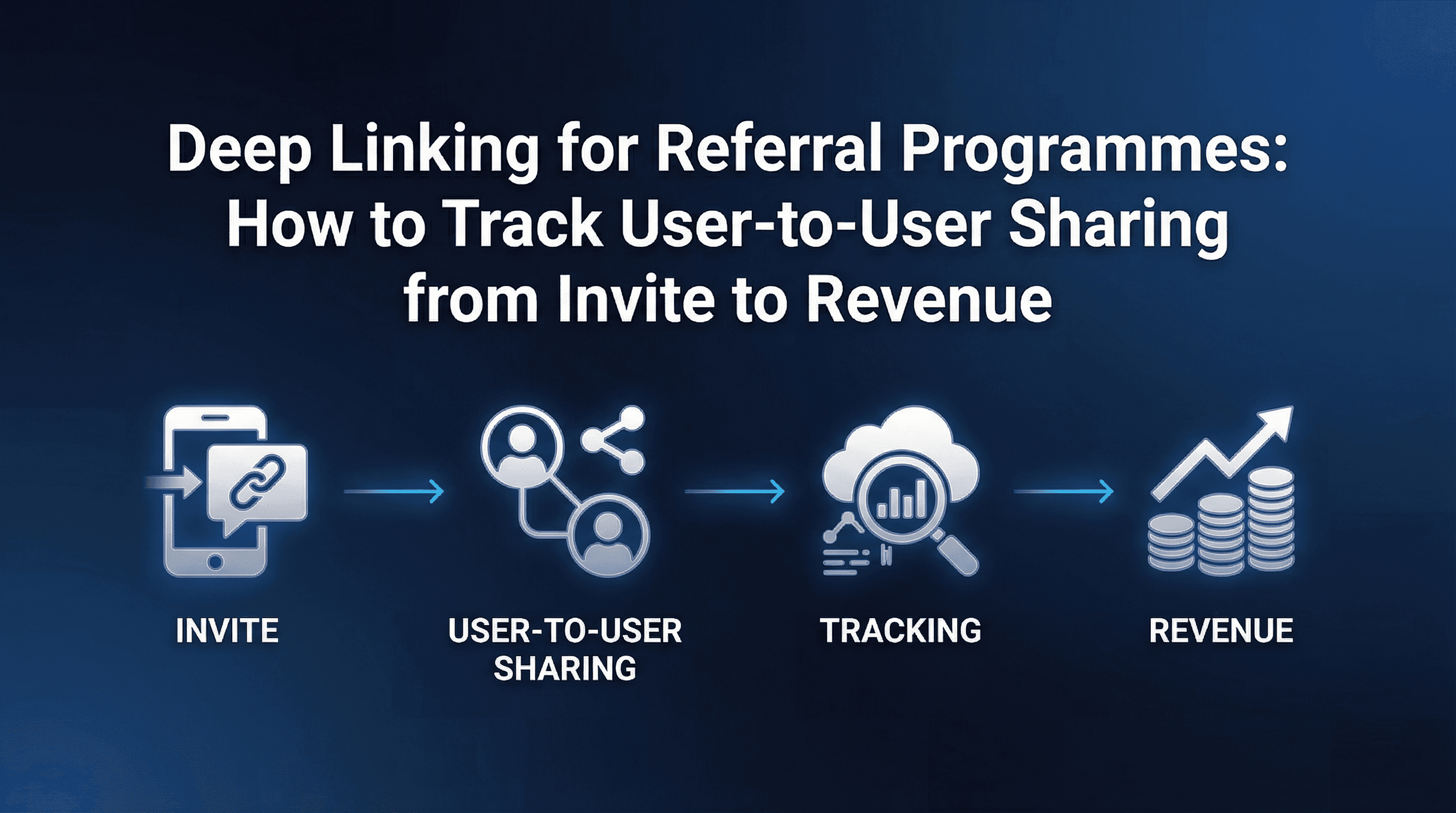
Referral programmes look simple on the surface. User A shares a link. User B taps it, installs the app, and both get a reward. Three steps. Done.
Except it almost never works that cleanly. The link loses context when User B hits the app store. The install gets attributed to organic instead of the referral. User B completes signup, but the backend can't connect them to User A. Rewards fire incorrectly, or don't fire at all. And the growth team has no idea whether the programme is actually driving incremental users or just rewarding installs that would have happened anyway.
The tracking gap between "invite sent" and "reward earned" is where most referral programmes quietly break. And deep linking is the infrastructure layer that either holds it together or lets it fall apart.
This playbook covers the full technical and measurement stack: generating unique referral links per user, preserving referrer identity through app install, triggering accurate two-sided rewards, measuring viral coefficients, and catching fraud before it drains your incentive budget.
Why Referral Attribution Is Harder Than It Looks
Standard paid UA attribution follows a relatively predictable path. An ad network serves an impression, a user clicks, an MMP captures the click, and the install gets attributed to the campaign. The advertiser and the ad network are known entities. The click URL is pre-configured with UTM parameters and campaign metadata.
Referral attribution breaks this pattern in several ways.
First, the "source" is another user, not an ad network. Every referrer needs a unique link, which means you're generating thousands or millions of tracking URLs instead of dozens. Second, the referral happens across surfaces you don't control: WhatsApp messages, Instagram DMs, SMS threads, Telegram groups, email forwards. Each surface strips, modifies, or wraps URLs differently.
Third, and most critically, the referred user often doesn't have the app installed. They tap the link, land in the App Store or Play Store, install the app, and open it. Somewhere in that three-step redirect, the referrer identity needs to survive. Without reliable deferred deep linking, that context evaporates the moment the user hits the store page.
The result is a common pattern across growth teams: the referral programme technically exists, users share links, new installs trickle in, but the attribution chain is broken. Rewards misfire, the inviter gets frustrated, and the team can't calculate whether the programme is ROI-positive because the data connecting inviter to invitee is incomplete.
How Deep Links Power Referral Programmes
Deep links solve the referral tracking problem by encoding referrer identity into the link itself and preserving that identity through every redirect, including app installation.
Here is the five-step flow when deep linking is properly implemented.
Link generation. User A taps "Invite a Friend." The app generates a unique deep link containing User A's referral identifier, campaign metadata, and reward tier info.
Sharing. User A shares the link via WhatsApp, SMS, social media, or email. The link is a standard HTTPS URL that works across every platform.
Click and routing. User B taps the link. If the app is installed, User B lands on the referral screen with referrer context intact. If not, the system routes User B to the appropriate app store.
Deferred context preservation. After User B installs and opens the app for the first time, the deep linking SDK retrieves the original link parameters, including User A's referral identifier, from the server. The app now knows exactly who referred this new user.
Attribution and reward. The backend matches User B's first-open event to User A's referral link and triggers the two-sided reward logic.
Without deferred deep linking, Step 4 doesn't happen. The install shows up as organic. The reward logic has no referrer to credit.
This is why implementing dynamic deep links with deferred context is not a nice-to-have for referral programmes. It's the foundational infrastructure that makes tracking possible at all.
Generating Unique Referral Links at Scale
Every user who can refer someone needs their own unique link. For an app with 100,000 active users, that's potentially 100,000 unique deep links, each carrying the correct referrer identifier and campaign metadata. There are two primary approaches.
SDK-Triggered Generation
The app's deep linking SDK creates a new link in real time when the user taps the share button, populating it with the user's ID, referral campaign identifier, and contextual parameters. This is lightweight and requires no backend coordination, though link creation depends on the SDK call succeeding.
API-Generated Links
For programmes that require pre-generated links (displayed on referral dashboards, embedded in profile pages, or included in email campaigns), server-side API generation is more reliable. The backend creates the link during registration or on a schedule, stores it alongside the user record, and serves it whenever the referral UI is rendered. API generation also supports batch operations for cohort-based campaigns or offline distribution via QR codes.
In-App Share Sheets
Native share sheets let users share directly to WhatsApp, Telegram, Messages, or email without copy-pasting URLs. The deep link should use a short, branded domain (e.g., yourapp.link/invite/xyz) rather than raw parameter-heavy URLs. Branded short links build trust and improve tap-through rates.
Preserving Referrer Context Through App Install
Deferred deep linking is the single most important technical capability for referral programme tracking. Without it, any referral where the invitee doesn't already have the app installed becomes untrackable.
The challenge is straightforward: app stores do not pass URL parameters forward. When a user taps a referral link, gets redirected to the store, installs the app, and opens it, the original referrer metadata is gone. Deferred deep linking stores the original link parameters server-side at the moment of the click, then matches the subsequent first app open back to that stored click using device identifiers, IP address, timestamp correlation, and probabilistic signals.
The accuracy of this matching determines whether your referral programme can attribute installs correctly. Several factors affect reliability in referral contexts.
Time-to-install gap. If the invitee doesn't install for hours or days, the matching window may expire. Most platforms use a 24-hour window, though referrals shared via email or social posts may benefit from longer windows.
Shared network environments. When referrer and invitee are on the same Wi-Fi (common in household referrals), IP-based matching can produce false positives.
iOS privacy restrictions. ATT consent and reduced IDFA availability make deterministic matching harder on iOS. The deep linking platform's ability to combine multiple attribution signals accurately directly impacts referral attribution quality.
In-app browser redirects. Links opened inside WhatsApp, Instagram, or Facebook load in embedded browsers, which handle redirects differently from system browsers. The deep linking solution must handle these gracefully.
Two-Sided Reward Attribution: Connecting Inviter to Invitee Actions
Referral programmes are unique in that they require two-sided attribution. The system must credit the referrer (User A) for a successful invite and simultaneously credit the referred user (User B) for completing the qualifying action.
This creates a chain of dependencies that must all resolve correctly.
The Attribution Chain
Link click logged. User B taps User A's referral link. The deep linking platform records User A's referrer ID, click timestamp, and device data.
Install attributed. User B installs and opens the app. Deferred deep linking matches this first open to the click, retrieving User A's referrer ID.
Qualifying event completed. User B completes the required action (signup, first purchase, subscription). The backend checks whether User B arrived via a referral link.
Reward triggered for both sides. The system credits User B's reward (welcome bonus, discount) and User A's reward (credits, cash, premium features).
Where Two-Sided Attribution Breaks
Delayed qualifying events. If User B doesn't complete the qualifying action for weeks, the referral attribution session may have expired. Define a clear referral attribution window (typically 7 to 30 days post-install) and communicate it to users.
Multiple referral links. User B may have tapped links from both User A and User C before installing. Your model needs a clear rule: first-click or last-click. Last-click is most common, but first-click better rewards the initial discoverer.
Reinstalls and returning users. If User B previously had the app, uninstalled it, and then taps a referral link, the system needs to decide whether this counts. Most programmes exclude reinstalls, but the deep linking layer must correctly identify returning users.
Validation Checklist
Before launching, run these checks:
Generate a referral link from a test account and share it via WhatsApp, SMS, and email.
Open each link on a device without the app installed. Verify app store redirects work.
Install the app and confirm first-open retrieves the correct referrer ID.
Complete the qualifying event and verify both accounts receive the correct reward.
Test edge cases: same Wi-Fi network, 24-hour install delay, in-app browsers, reinstall scenario.
Measuring Viral Loops: K-Factor, Viral Coefficient, and Referral Payback Period
A referral programme is a growth channel, and like any channel, it needs measurement rigour. Three metrics define whether yours is working.
K-Factor (Viral Coefficient)
K-factor measures how many new users each existing user brings in through referrals.
K = (average invites sent per user) x (conversion rate per invite)
If the average user sends 5 invites and 10% of those invites convert to installs, K = 0.5. Each user brings in half a new user on average.
A K-factor above 1.0 means the programme is self-sustaining: every user brings in more than one new user, creating exponential growth. In practice, very few programmes sustain K > 1.0 over time. Most healthy referral programmes operate between 0.15 and 0.7, supplementing paid acquisition rather than replacing it.
Track K-factor by cohort, not as a blended average. Week-over-week cohort K-factor reveals whether the programme is gaining or losing momentum.
Referral Conversion Funnel
K-factor is the summary metric, but the funnel beneath it tells you where to optimise.
Invite rate: What percentage of active users send at least one invite? Typical: 5 to 15%.
Shares per inviter: How many invites does the average inviter send? Typical: 3 to 8.
Click-through rate: What percentage of received invites result in a tap? WhatsApp and SMS typically convert 15 to 30%. Social media posts convert 2 to 8%.
Install rate: What percentage of clicks convert to installs? Typical: 20 to 40% for well-optimised store pages.
Activation rate: What percentage of referred installs complete the qualifying action? Fintech apps (requiring KYC) see 30 to 50%. Gaming apps see 50 to 70%.
Measuring each stage reveals whether the bottleneck is awareness (low invite rate), link quality (low CTR), store conversion (low install rate), or onboarding friction (low activation). Each bottleneck has a different fix.
Referral Payback Period
The payback period measures how quickly the referral programme's cost (rewards paid out) is recovered through the referred user's revenue.
Payback period = (total reward cost per successful referral) / (average revenue per referred user per day)
If you pay ₹200 total in rewards (₹100 to each side) and the average referred user generates ₹15/day in revenue, the payback period is roughly 13 days.
Compare this to your paid UA payback period. If paid channels pay back in 45 to 60 days but referrals pay back in 15 to 20 days, the referral programme is a significantly more efficient growth channel, and that comparison is what justifies continued investment in the programme.
Fraud Prevention in Referral Programmes
Referral fraud is a distinct problem from ad fraud. The attack vectors are different, and the financial exposure is direct because you're paying out real rewards, not just wasting impressions.
Common Referral Fraud Patterns
Self-referral. Users create multiple accounts and refer themselves to collect rewards on both sides. The most common and easiest to miss.
Device farms. Organised operations use dozens of devices to install apps through referral links, collect rewards, and repeat. Installs are real, but users never engage.
Reward gaming. Users complete the minimum qualifying action (e.g., a ₹1 transaction) to trigger rewards, then never return. Not technically fraud, but it inflates metrics while delivering zero value.
Incentivised sharing groups. Referral links posted in Telegram or WhatsApp groups where users trade installs. Real installs, zero organic intent.
Detection and Prevention
Build these checks in from day one:
Device-level deduplication. Flag or block rewards when referrer and invitee share device identifiers or IP addresses in quick succession.
Behavioural thresholds. Require a meaningful qualifying event. "First purchase over ₹500" is harder to game than "signup completed."
Velocity limits. Cap successful referrals per user per time period. Fifty referrals in a day is a flag, not a celebration.
Post-install engagement checks. Hold rewards for 24 to 72 hours and validate genuine engagement (session length, feature usage) before releasing.
Cohort comparison. Compare referred user retention and revenue against organic and paid cohorts. If referred users show significantly worse D7 retention, fraud or incentivised installs are likely inflating numbers.
Frequently Asked Questions
What is a referral deep link?
A referral deep link is a unique URL generated for each user that encodes their referrer identity as a parameter. When another user taps the link, installs the app, and completes a qualifying action, the embedded metadata connects the new user back to the referrer for reward attribution. Unlike standard tracking links, referral deep links must support deferred context preservation so the referrer identity survives the app store installation process.
How does deferred deep linking work for referral programmes?
When a referred user taps a referral link without the app installed, deferred deep linking stores the link's parameters server-side at the moment of the click. After the user installs and opens the app, the SDK retrieves those stored parameters, allowing the app to identify who referred the new user and route them to the correct screen.
What is a good K-factor for a referral programme?
A K-factor above 1.0 means exponential viral growth, but this is rarely sustained. Most successful programmes operate between 0.15 and 0.7, meaning referrals meaningfully supplement paid acquisition. Track K-factor by weekly install cohort rather than as a blended average.
How do you prevent self-referral fraud?
Implement device-level deduplication, require meaningful qualifying events beyond simple signup, apply velocity limits on referrals per user per time period, and hold rewards for a 24 to 72 hour validation window before payout.
Should referral rewards be paid on install or on a downstream event?
Always tie rewards to a downstream qualifying event. Rewarding on install alone invites fraud and attracts low-quality users who never engage. Tying rewards to first purchase, subscription activation, or an in-app milestone ensures only engaged referred users trigger payouts.
Key Takeaways
Referral programmes are one of the highest-ROI growth channels available to mobile apps, but only when the tracking infrastructure is solid. The foundation is deferred deep linking that reliably preserves referrer context through app store installation. On top of that, you need unique link generation at scale, a two-sided reward service with fraud validation, and a measurement layer that tracks the full funnel from invite sent to revenue generated.
Build the infrastructure in three to four weeks. Measure K-factor, referral payback period, and referred user quality by cohort from day one. Compare referral channel economics against paid UA, because that comparison is what turns a referral programme from a feature into a growth engine.
If your team is looking for a simpler way to unify referral tracking with existing paid attribution without managing separate tools, request a demo from Linkrunner to see how dynamic link generation and full-funnel attribution work inside a single platform.