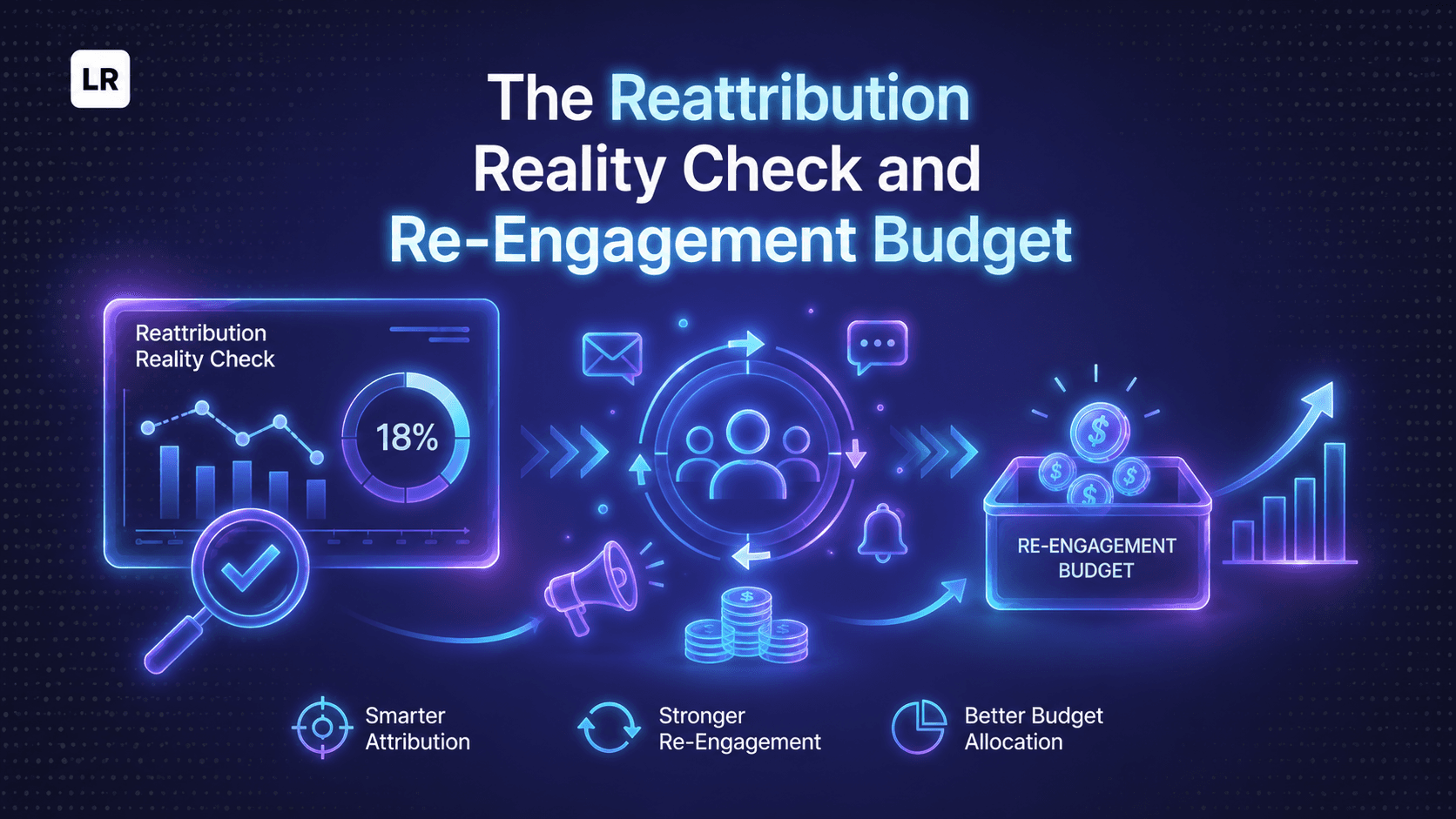
The Reattribution Reality Check and Re-Engagement Budget

Lakshith Dinesh
Updated on: May 18, 2026
Re-engagement budgets across consumer mobile apps are growing faster than the audience that justifies them. On the Linkrunner network, the median project sees a reattribution rate of just 1.42% over the last 30 days, and three-quarters of projects sit under 2.67%. That is the actual size of the prize. Most teams are spending against a number five to ten times larger.
This post breaks down what the benchmark actually measures, why the typical reattribution opportunity is smaller than agencies and CRM tools tend to suggest, and how to right-size the re-engagement line item in your next budget review.
What Reattribution Actually Means (And What It Does Not Mean)
Reattribution: the act of crediting a returning user's install or app open to a new campaign because they re-engaged with marketing after their previous attribution window had closed. It is measured per install event, not per session, and is distinct from retargeting (a campaign type) or remarketing (a tactic).
Three terms get used interchangeably in budget conversations, and they should not:
Reattribution. A formal attribution event flagged by the MMP. Strict definition, strict count.
Retargeting. A campaign objective on Meta, Google, TikTok and others. The campaign exists whether or not it produces a reattribution.
Remarketing. A broader marketing tactic, often used loosely to mean any spend aimed at existing users.
The confusion shows up in budget reviews where the line item is named "re-engagement" but the actual underlying KPI is a session count, a push-notification open rate, or a retargeting CPM. None of those are reattribution. Our guide to attribution for re-engagement campaigns covers the measurement workflow in more detail; this post is about the headline benchmark.
The Linkrunner Benchmark: Median Project Rate 1.42%
Across 60+** Linkrunner projects with at least 500 installs in the 30 days to 14 May 2026**, the per-project reattribution rate distribution looks like this:
P25: 0.54%
Median: 1.42%
P75: 2.67%
Max: 41.87% (a single outlier project running heavy reactivation)
The pooled rate across the same sample (total reattributions divided by total installs) is 3.37%, but that number is pulled up by a handful of high-volume reattribution-heavy projects. The number that matters for most readers is the per-project median.
Methodology note: rows from the Linkrunner productionInstalltable whereis_reattribution = true, 30-day window, projects with under 500 installs in the window excluded to avoid small-sample noise. The sample is India-skewed but covers every vertical tracked on the platform.
Two things worth noting from the spread. First, the typical app's reattribution rate sits between half a percent and three percent. Second, even at the 75th percentile, fewer than three in every hundred install events are reattributions. The 1.42% median is not a low outlier; it is the realistic centre of the distribution.
Why Most Teams Overestimate the Reattribution Opportunity
Three patterns inflate the perceived size of the reattribution pool in budget conversations.
Confusing returning sessions with reattributions. A user who opens the app daily produces many sessions but zero reattributions. Session counts are large, reattribution counts are not. Mixing the two makes the opportunity look bigger than it is.
Counting paid retargeting impressions as "reactivations." A retargeting campaign can deliver millions of impressions and produce a tiny number of actual reattribution events. The campaign report shows scale; the attribution report shows the truth.
The "dormant user pool is huge" fallacy. Most dormant users will never reinstall, regardless of spend. The MMP-visible reactivation pool is much smaller than the lifetime dormant base, because the user must complete an install event for the reattribution to register at all.
Our piece on why paid installs can cannibalise organic growth covers a related measurement trap where paid spend takes credit for users it did not actually move.
The Real Attribution Chain for a Reactivated User
Reattribution requires a specific sequence to register, and configuration choices change the count in either direction.
Inactivity window (Linkrunner default: 0 days). The minimum time a user must be inactive before they are eligible to be reattributed.
Reattribution eligibility window (Linkrunner default: 90 days). The maximum time after the previous attribution within which a new ad touch can take credit.
Trigger. A new click on a tracked ad or link, followed by an app open. Deep link opens, push taps with valid attribution parameters, and re-ad clicks all qualify if configured.
Credit. The MMP moves credit from the original campaign to the new campaign and flags the install row with
is_reattribution = true.
Changing the inactivity window from 0 days to 7 days will reduce the reattribution count, sometimes materially. Extending the eligibility window past 90 days will increase it, sometimes materially. If your team has not reviewed these settings in the last six months, the benchmark above will not be apples-to-apples with your own number until you do.
How to Right-Size the Re-Engagement Budget
The benchmark is useful only if it changes a spending decision. Here is a defensible way to translate the 1-3% range into a budget ceiling for your next quarter.
Pull your last 90 days of installs and reattributions from your MMP. Compute the reattribution rate per month.
Multiply the monthly install volume by the reattribution rate. That is your maximum addressable reactivation pool, by definition.
Set a target cost per reactivation no higher than your current paid CPI. A reactivated user is usually less valuable than a fresh install in the same vertical because they have already churned once.
Cap re-engagement spend at (addressable pool x target cost). Anything beyond that is paying for impressions and sessions, not for reattributions.
For verticals with strong subscription or whale economics, the per-reactivation value can justify a higher cost, but the cap should still be calculated, not assumed. Our analysis on how an MMP shortens CAC payback by 20 to 40% across verticals is a useful companion piece for the cost-per-reactivation modelling.
The Verticals Where Reattribution Actually Pays Back
The 1.42% median is the network centre. Three vertical patterns shift it materially.
Gaming. Whale recovery is genuine. Mid-tier and high-spending gamers who have lapsed for 30 to 60 days do reinstall in response to creative refresh and re-ad targeting. Gaming is the vertical most likely to clear the 3% reattribution rate threshold legitimately.
Subscription apps. Trial reactivation and lapsed-renewal flows generate real reattribution volume, particularly around free trial expiry and discount-led winback windows.
Fintech and eCommerce. Lower reattribution payback in most cases. Users who churn from a banking or wallet app have typically moved their funds; eCommerce users have moved to a competitor or to web. Spend here should be modest.
Our attribution data for retention marketing guide covers the segmentation work that sits underneath these vertical patterns.
The 20-Minute Audit: Real Reattribution or Fake Reattribution?
Three diagnostic queries to run on your MMP this week.
Pull your reattribution rate per channel. If push notifications report higher reattribution rates than Meta retargeting, ask whether push opens are being mapped to attribution events correctly. The mapping is often too loose.
Check your inactivity window setting. If it is at 0 days, you are counting users who returned the same day as reattributions. Many teams find this overstates the number.
Spot-check ten reattributed users. Pull the original click, the original install, and the reattribution click. Confirm the chain looks like a genuine reactivation rather than the same user being credited twice in a short window.
Our list of 5 MMP metrics most teams ignore that actually predict churn and LTV is the natural next read once you have right-sized the budget.
Frequently Asked Questions
What is a normal reattribution rate?
On the Linkrunner network in the 30 days to 14 May 2026, the median project saw a reattribution rate of 1.42%, with the middle 50% of projects between 0.54% and 2.67%. Gaming and subscription apps tend to clear the higher end of that range; fintech and eCommerce typically sit lower.
Is reattribution the same as retargeting?
No. Retargeting is a campaign objective on ad platforms. Reattribution is an attribution event recorded by the MMP when a returning user's install or app open is credited to a new campaign. A retargeting campaign can run for months and produce a small number of reattributions, or a large number, depending on the audience and the offer.
How long should the inactivity window be?
There is no universal answer, but 7 days is a defensible starting point for most consumer apps. A 0-day window counts same-day returning users as reattributions, which most teams find overstates the number. A 30-day window is appropriate for low-frequency verticals like travel or tax filing.
Does push notification engagement count as a reattribution?
Only if the push tap routes through a tracked deep link that the MMP can attribute, and only if the user meets the inactivity window. A push open by an active user is not a reattribution; a push open by a user who has been dormant past the inactivity window, on a campaign-tagged link, generally is.
How does reattribution affect ROAS calculations?
Reattribution moves install credit from the original campaign to the new campaign. ROAS for the original campaign drops; ROAS for the reattributing campaign rises. If you do not separate fresh installs from reattributions in your ROAS view, you are mixing two different acquisition motions with different cost economics.
Where to Go From Here
The reattribution number is not the problem. The problem is treating it as bigger than it is. A 1 to 3% addressable pool is real and worth spending against, but it is a tightly capped opportunity, not a growth lever.
If you would like to see how Linkrunner exposes reattribution rates and the underlying configuration settings in the dashboard, with cleaner cuts by channel and campaign, request a demo at linkrunner.io.